Guna Milan is a traditional Vedic compatibility framework commonly organised as Ashtakoota: eight factors contributing up to 36 gunas. The result shows how the score is distributed across separate themes. It does not prove relationship quality and should not become an automatic permission for, or ban on, marriage.
The birth data behind the calculation
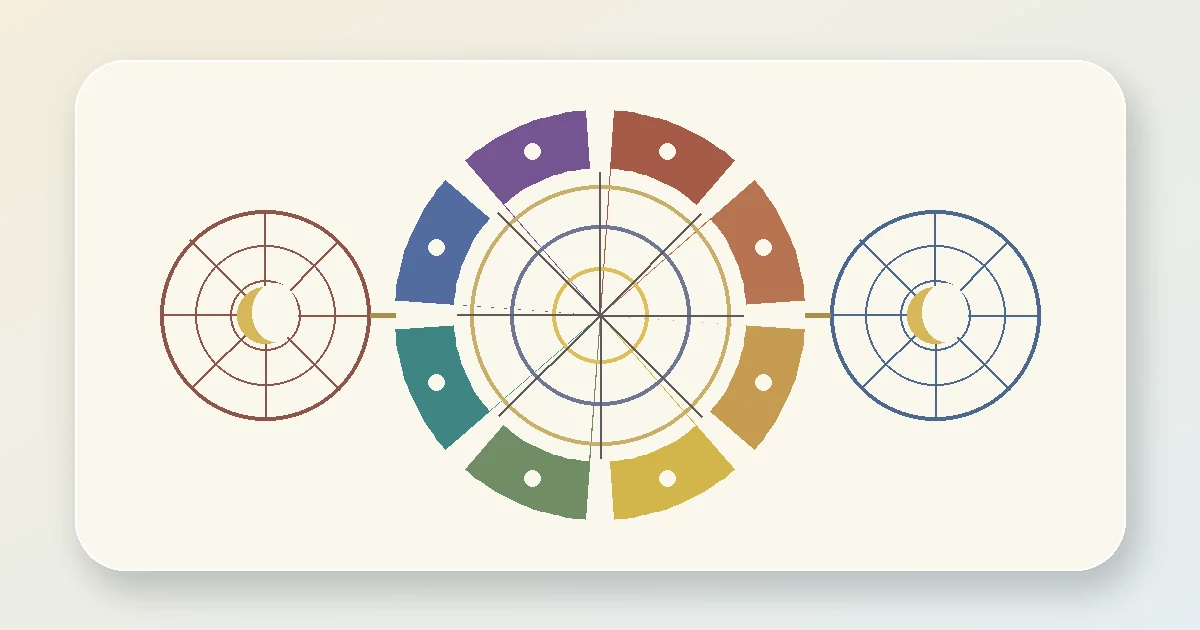
Guna Milan commonly compares the Moon’s nakshatra and sign for two people. Establishing those positions requires the date, place and time of birth. When the Moon crossed a nakshatra boundary on that date, a small timing error can alter part of the calculation, so uncertainty should be stated rather than concealed.
A brief Guna Milan report is not the same as a full comparison of two Kundlis. The former offers an eight-factor structure; a broader chart analysis may consider houses, planetary rulers, Navamsha, dashas and other elements used by a particular tradition.
The eight kootas and their weights
A widely used Ashtakoota allocation is:
- Varna — 1 point
- Vashya — 2 points
- Tara or Dina — 3 points
- Yoni — 4 points
- Graha Maitri — 5 points
- Gana — 6 points
- Bhakoot or Rashi — 7 points
- Nadi — 8 points
Together they make 36. The factors do not all describe the same kind of compatibility, and terminology varies by school and language. A useful report explains the components instead of displaying only a large total.
Reading more than the headline score
Note the total, then inspect its construction. Which two factors are strongest? Which two contribute least? Is the result sensitive to uncertain birth time? Translate the symbolic themes into real questions about decision-making, recovery after conflict, shared responsibility and ways of expressing closeness.
Traditional thresholds may be used inside the system, but a threshold does not measure respect or maturity. Schools also differ in the exceptions and cancellation rules applied to particular doshas. An automated result should therefore identify its formula rather than present itself as universal.
Same total, different relationship map
Imagine two pairs that both receive 24 out of 36. The first has moderate scores across almost every factor. The second combines several high scores with one very low result in a heavily weighted area. The total matches; the pattern does not.
A practical reading does not declare the second pair unsafe. It asks whether the highlighted theme appears in observable disagreements and what agreement might help. For instance, the pair can define how major family decisions will be timed and review after two weeks whether pressure and avoidance have decreased.
Quality checklist
Before relying on a report, check for:
- accurate birth details for both people;
- a named method and all eight factors;
- component scores, not only the total;
- clear treatment of uncertain time;
- no guarantee of marriage or separation;
- a practical next question instead of fear-based language.
Traditional terms should be explained in a contemporary way and must not turn gender, origin or social hierarchy into a judgment of human worth.
Boundaries of Guna Milan
The calculation cannot establish consent, safety, fidelity, care or willingness to take responsibility. A high total does not cancel concerning behaviour; a low one does not prove that a union is impossible. Major choices belong to the people involved and should be based on evidence, values and free agreement.
Practical protocol: Guna Milan
Use a short, repeatable protocol for “How Guna Milan works and what the result shows” rather than an unrestricted reading. This article focuses on the calculation and reading sequence. The aim is to separate input data from interpretation, choose one testable conclusion, and prevent a general statement from being mistaken for a fact.
- Define the task. Write one specific question connected with “Guna Milan”. Keep it about your response, choice, or an observable situation rather than a guaranteed prediction.
- Save the inputs. Record the date, time, wording, selected method, and calculation settings. This makes it possible to explain why two results agree or differ.
- Separate the layers. Mark calculated or entered data, symbolic meaning, and your personal association as three different layers. Do not merge them into one claim.
- Choose one action. Turn the conclusion into a small step that can be completed and checked. A useful step has a deadline, a clear completion criterion, and does not depend on another person’s behaviour.
- Review the note. Return after a day or after the defined event. Compare expectation with fact, keep the useful observation, and discard wording that only seemed accurate in hindsight.
Four layers of a sound interpretation
To keep “Guna Milan” from becoming a vague description, review four layers in order:
- Input data. What was entered or selected: a date, name, question, sequence, location, or another parameter required by the method.
- Method rule. How the result was produced: a formula, correspondence table, sequence of steps, house system, construction rule, or chosen tradition.
- Interpretation. What meaning is proposed and which elements support it. A hypothesis is acceptable here; replacing facts is not.
- Practical check. Which observable action or criterion will show whether the reading was useful to you.
Extended validation example: Guna Milan
Imagine that a reader opens “How Guna Milan works and what the result shows” because of the query “how Guna Milan works”. They save the original inputs and read the direct answer first. Next, they mark one element that can be checked and connect it with “Guna Milan result meaning”. Instead of deciding that the result fully describes the situation, they write a working hypothesis: “Today I will test whether this emphasis helps me choose the next step.”
The reader then assigns one action and a review time. After acting, they record three facts: what was done, what changed, and which part of the interpretation added no value. This preserves the reflective use of a symbolic method without allowing broad wording to replace actual experience.
How to evaluate the result
Do not score a reading by how familiar it sounds. Score whether it clarified the situation and supported a concrete decision. Use the table as a one-result journal.
| Check | Record | Useful sign |
|---|---|---|
| Input accuracy | Date, time, wording, and selected system | The result can be reproduced |
| Fit with the question | Which part addresses “how Guna Milan works” | No unrelated claims are added |
| Practical action | One step connected with “Guna Milan result meaning” | Deadline and completion criterion are clear |
| Second review | Fact, expectation, and difference | The conclusion is refined rather than forced |
When two interpretations disagree
First check whether both readings used the same inputs and the same method. Compare the supporting elements, not the most attractive wording. When systems differ, do not combine their conclusions mechanically. Keep two separate hypotheses and prefer the one that leads to a clearer and safer action. A contradiction is a reason to refine the question, not to repeat the calculation until the answer feels pleasant.
Check a series of observations
One convincing example does not establish lasting value for “Guna Milan”. Make three comparable entries with the same method. Record the question, inputs, first conclusion, and intended action before the outcome is known. Do not change calculation rules between entries, and do not delete cases in which no connection appears.
After the third entry, sort conclusions into three groups: clarified a decision, added no noticeable value, or created a wrong expectation. Keep only wording that repeatedly helped with “how Guna Milan works” or “Guna Milan result meaning”. This small series reduces the influence of coincidence and makes personal observation more honest.
Method and source transparency
Before publishing or saving a conclusion, state which system was used and which elements are calculated data. A source may support a formula, astronomical value, historical origin, or construction rule, but it does not by itself validate a symbolic meaning. This distinction matters for “How Guna Milan works and what the result shows”: the reader should see where a testable rule ends and an interpretive model begins.
Sources and method references
These references support calculated, historical, or methodological parts of the article; evaluate symbolic interpretation separately.
Questions for self-review
Before saving the interpretation, answer in writing:
- What exactly do I want to understand through “how Guna Milan works”?
- Which part of “Guna Milan result meaning” describes an observable fact, and which part is my assumption?
- What will change in my action if the conclusion about “Ashtakoota compatibility” is useful?
- What outcome would make me revise the interpretation?
- Can I explain the result in one sentence without labels or promises about the future?
Frequently asked questions
Which inputs should be checked before interpreting “How Guna Milan works and what the result shows”?
Verify the date, time, time zone, location, name spelling, and selected method, using only the fields actually required to calculate “Guna Milan”.
Why can another calculator show a different result?
It may use a different formula, correspondence table, rounding rule, time zone, house system, or transliteration. Compare settings before comparing meanings.
How do I separate calculation from symbolic interpretation?
Label four layers: entered data, calculated output, meaning assigned by the chosen tradition, and your personal association. Only the first two are directly reproducible.
When should I repeat the calculation?
Repeat it when an input was wrong or when you deliberately choose another method. Do not refresh the result merely to obtain more reassuring wording.
What does a useful conclusion look like?
It answers the original question, avoids promises about the future, and leads to one concrete action with a deadline and a review criterion.
Related materials
Continue the topic without repeating the same query:
- The 36 Gunas: a complete guide to meanings
- Kundli matching: a complete beginner’s guide
- Vedic numerology
Continue in Reflecta
Open the Vedic compatibility section, verify the place and time of birth, and inspect all eight factors rather than the total alone. For context, explore Vedic numerology, astrology and astrological compatibility as separate systems rather than combining them into a pseudo-precise score.
FAQ
Which inputs should be checked before interpreting “How Guna Milan works and what the result shows”?
Verify the date, time, time zone, location, name spelling, and selected method, using only the fields actually required to calculate “Guna Milan”.
Why can another calculator show a different result?
It may use a different formula, correspondence table, rounding rule, time zone, house system, or transliteration. Compare settings before comparing meanings.
How do I separate calculation from symbolic interpretation?
Label four layers: entered data, calculated output, meaning assigned by the chosen tradition, and your personal association. Only the first two are directly reproducible.
When should I repeat the calculation?
Repeat it when an input was wrong or when you deliberately choose another method. Do not refresh the result merely to obtain more reassuring wording.
What does a useful conclusion look like?
It answers the original question, avoids promises about the future, and leads to one concrete action with a deadline and a review criterion.
Sources and editorial method
This material is intended for learning and self-reflection. It does not promise to predict the future and does not replace professional help.