A Moon-today result combines astronomical information for a date and location with a separate interpretive layer. Phase, illumination, lunar age, moonrise and moonset are calculated data; zodiac meanings, lunar-day themes and recommendations are symbolic readings. Use the result as a planning and observation frame, not as proof that the Moon causes a personal event.
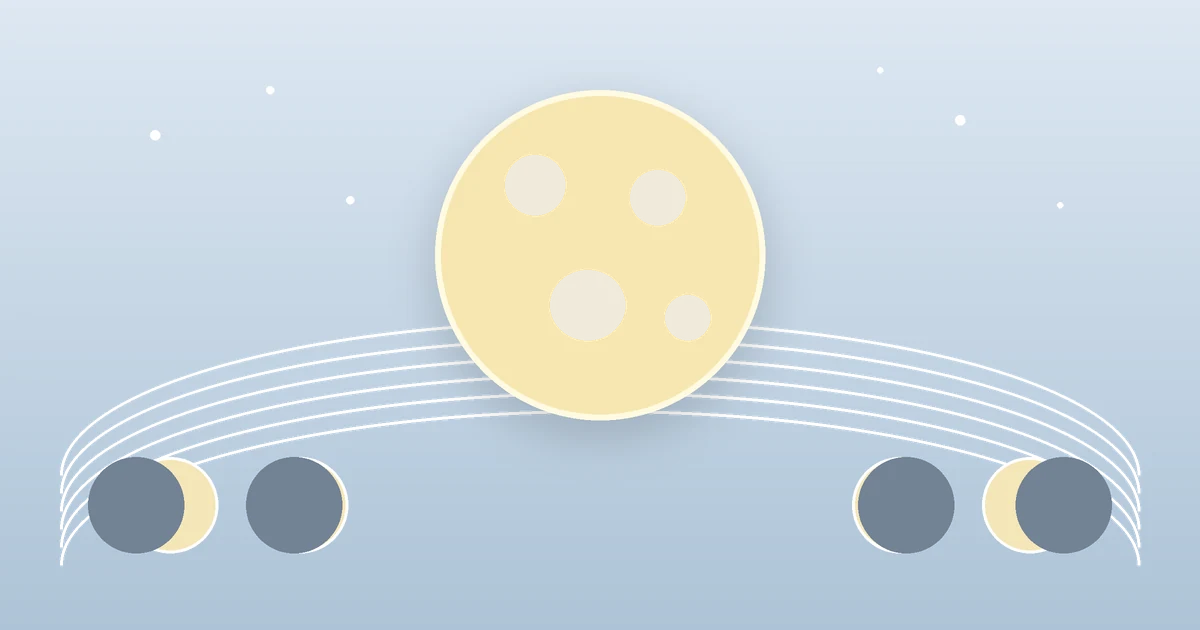
Read the data layer first
The Moon’s phase follows the geometry of the Sun, Earth and Moon. Illumination is the fraction of the visible lunar disc lit by sunlight, while lunar age counts time from the current new moon. Rise, transit and set times depend on the observer’s coordinates, date and time zone.
Those values are not interchangeable. Two dates can show similar illumination while one belongs to the waxing half of the cycle and the other to the waning half. A useful card therefore states both the phase and the direction of change.
Check location, time and method
Before interpreting anything, verify the selected city, time zone and date. Moonrise may occur on a different civil date than expected, and a result copied from another location can be misleading. Near a phase boundary, a few hours also matter.
If the page includes a zodiac sign or a numbered lunar day, look for the method. Tropical and sidereal zodiacs use different reference frames, and lunar-day traditions do not all define boundaries in the same way. A difference between calendars is not necessarily a calculation error; it may be a difference in conventions.
What the symbolic layer is for
A symbolic reading works best as a prompt. New moon can frame intention setting, the waxing cycle gradual development, full moon review and visibility, and the waning cycle completion or reduction. This is a planning vocabulary, not a physical command that makes an outcome happen.
Turn any recommendation into a testable sentence:
- observation: what the card actually reports;
- theme: one possible way to frame it;
- action: a small step under your control;
- review: evidence you will examine later.
“Waxing Moon: expand” could become “add one validated item to the project scope, then check whether it improved the result rather than merely increasing work.”
A worked example
Imagine the card shows a waxing gibbous phase, bright evening visibility and an interpretive theme of refinement. You are preparing a presentation. A literal reading might promise success because the Moon is favourable. A grounded reading asks you to review the draft, remove one unclear slide and test the main point on another person.
The evening check is concrete: did the listener understand the proposal without extra explanation? The lunar frame helped organise attention, but the evidence comes from the conversation.
Mistakes that distort the result
Do not treat illumination as the phase name, use another city’s rise time, mix two lunar-calendar systems, or infer another person’s feelings from a Moon placement. Avoid refreshing the result to obtain a more reassuring message. Most importantly, do not use it instead of medical, legal, financial or safety information.
A two-minute daily note
Record the phase, one location-specific fact, one chosen theme and one action. At the end of the day mark the action as done or not done and write one sentence about its effect. After a month, review the notes for useful patterns without forcing every day to match the interpretation.
Practical protocol: Moon today
Use a short, repeatable protocol for “Moon today: how the result is calculated and what it can show” rather than an unrestricted reading. This article focuses on the calculation and reading sequence. The aim is to separate input data from interpretation, choose one testable conclusion, and prevent a general statement from being mistaken for a fact.
- Define the task. Write one specific question connected with “Moon today”. Keep it about your response, choice, or an observable situation rather than a guaranteed prediction.
- Save the inputs. Record the date, time, wording, selected method, and calculation settings. This makes it possible to explain why two results agree or differ.
- Separate the layers. Mark calculated or entered data, symbolic meaning, and your personal association as three different layers. Do not merge them into one claim.
- Choose one action. Turn the conclusion into a small step that can be completed and checked. A useful step has a deadline, a clear completion criterion, and does not depend on another person’s behaviour.
- Review the note. Return after a day or after the defined event. Compare expectation with fact, keep the useful observation, and discard wording that only seemed accurate in hindsight.
Four layers of a sound interpretation
To keep “Moon today” from becoming a vague description, review four layers in order:
- Input data. What was entered or selected: a date, name, question, sequence, location, or another parameter required by the method.
- Method rule. How the result was produced: a formula, correspondence table, sequence of steps, house system, construction rule, or chosen tradition.
- Interpretation. What meaning is proposed and which elements support it. A hypothesis is acceptable here; replacing facts is not.
- Practical check. Which observable action or criterion will show whether the reading was useful to you.
Extended validation example: Moon today
Imagine that a reader opens “Moon today: how the result is calculated and what it can show” because of the query “what phase is the Moon today”. They save the original inputs and read the direct answer first. Next, they mark one element that can be checked and connect it with “lunar day today”. Instead of deciding that the result fully describes the situation, they write a working hypothesis: “Today I will test whether this emphasis helps me choose the next step.”
The reader then assigns one action and a review time. After acting, they record three facts: what was done, what changed, and which part of the interpretation added no value. This preserves the reflective use of a symbolic method without allowing broad wording to replace actual experience.
How to evaluate the result
Do not score a reading by how familiar it sounds. Score whether it clarified the situation and supported a concrete decision. Use the table as a one-result journal.
| Check | Record | Useful sign |
|---|---|---|
| Input accuracy | Date, time, wording, and selected system | The result can be reproduced |
| Fit with the question | Which part addresses “what phase is the Moon today” | No unrelated claims are added |
| Practical action | One step connected with “lunar day today” | Deadline and completion criterion are clear |
| Second review | Fact, expectation, and difference | The conclusion is refined rather than forced |
When two interpretations disagree
First check whether both readings used the same inputs and the same method. Compare the supporting elements, not the most attractive wording. When systems differ, do not combine their conclusions mechanically. Keep two separate hypotheses and prefer the one that leads to a clearer and safer action. A contradiction is a reason to refine the question, not to repeat the calculation until the answer feels pleasant.
Check a series of observations
One convincing example does not establish lasting value for “Moon today”. Make three comparable entries with the same method. Record the question, inputs, first conclusion, and intended action before the outcome is known. Do not change calculation rules between entries, and do not delete cases in which no connection appears.
After the third entry, sort conclusions into three groups: clarified a decision, added no noticeable value, or created a wrong expectation. Keep only wording that repeatedly helped with “what phase is the Moon today” or “lunar day today”. This small series reduces the influence of coincidence and makes personal observation more honest.
Method and source transparency
Before publishing or saving a conclusion, state which system was used and which elements are calculated data. A source may support a formula, astronomical value, historical origin, or construction rule, but it does not by itself validate a symbolic meaning. This distinction matters for “Moon today: how the result is calculated and what it can show”: the reader should see where a testable rule ends and an interpretive model begins.
Sources and method references
These references support calculated, historical, or methodological parts of the article; evaluate symbolic interpretation separately.
Questions for self-review
Before saving the interpretation, answer in writing:
- What exactly do I want to understand through “what phase is the Moon today”?
- Which part of “lunar day today” describes an observable fact, and which part is my assumption?
- What will change in my action if the conclusion about “moonrise and moonset today” is useful?
- What outcome would make me revise the interpretation?
- Can I explain the result in one sentence without labels or promises about the future?
Frequently asked questions
Which inputs should be checked before interpreting “Moon today: how the result is calculated and what it can show”?
Verify the date, time, time zone, location, name spelling, and selected method, using only the fields actually required to calculate “Moon today”.
Why can another calculator show a different result?
It may use a different formula, correspondence table, rounding rule, time zone, house system, or transliteration. Compare settings before comparing meanings.
How do I separate calculation from symbolic interpretation?
Label four layers: entered data, calculated output, meaning assigned by the chosen tradition, and your personal association. Only the first two are directly reproducible.
When should I repeat the calculation?
Repeat it when an input was wrong or when you deliberately choose another method. Do not refresh the result merely to obtain more reassuring wording.
What does a useful conclusion look like?
It answers the original question, avoids promises about the future, and leads to one concrete action with a deadline and a review criterion.
Related materials
Continue the topic without repeating the same query:
Explore the context in Reflecta
Use the lunar calendar for the selected date and place. Compare it with a personal forecast for today, explore the broader symbolic framework through astrology, and keep recurring night material in the dream journal.
FAQ
Which inputs should be checked before interpreting “Moon today: how the result is calculated and what it can show”?
Verify the date, time, time zone, location, name spelling, and selected method, using only the fields actually required to calculate “Moon today”.
Why can another calculator show a different result?
It may use a different formula, correspondence table, rounding rule, time zone, house system, or transliteration. Compare settings before comparing meanings.
How do I separate calculation from symbolic interpretation?
Label four layers: entered data, calculated output, meaning assigned by the chosen tradition, and your personal association. Only the first two are directly reproducible.
When should I repeat the calculation?
Repeat it when an input was wrong or when you deliberately choose another method. Do not refresh the result merely to obtain more reassuring wording.
What does a useful conclusion look like?
It answers the original question, avoids promises about the future, and leads to one concrete action with a deadline and a review criterion.
Sources and editorial method
This material is intended for learning and self-reflection. It does not promise to predict the future and does not replace professional help.