An online Leela board is most useful when it reduces friction without turning the facilitator into an oracle. The board, rules, notes, and move history remain in one place; AI can add a clearly labeled second perspective after the player has written their own.
Article focus: Practical: open the online Leela board, understand the available tools, and run a responsible first session
You can open Leela in Reflecta in a browser. For a first attempt, use a 15- to 20-minute session rather than trying to complete the whole board.
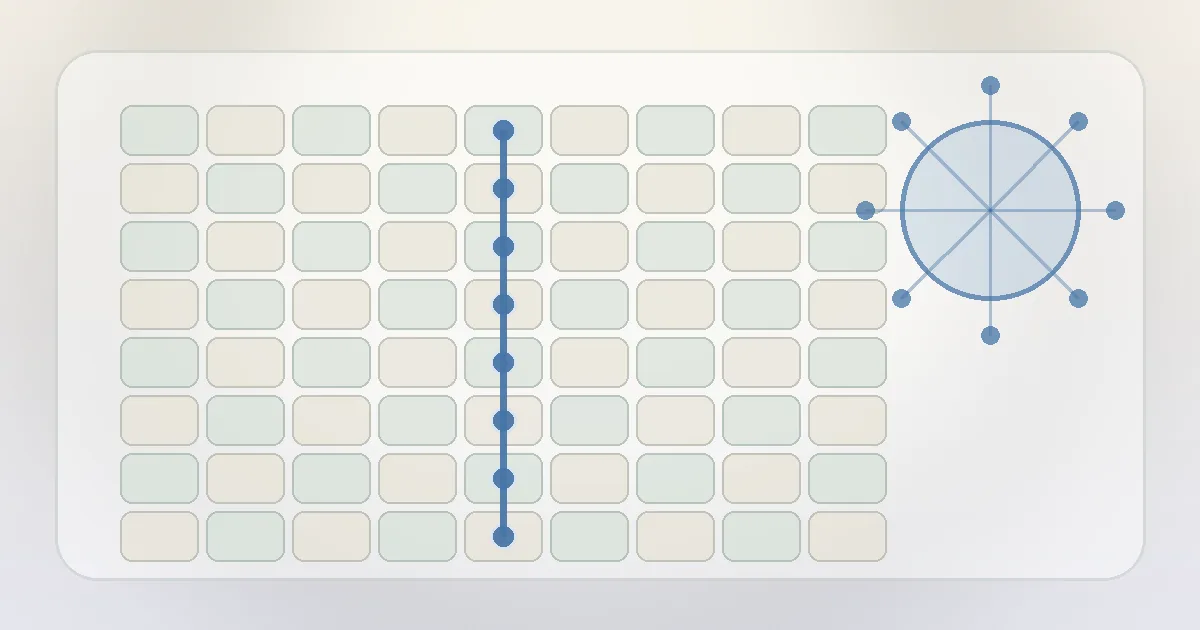
The route marks the sequence of moves; the network represents connections among the intention, the player’s notes, and an optional AI response.
What the online version puts in one place
A digital session can include:
- the board and current position;
- the die roll and rule-based transition;
- the cell description;
- a private response after each move;
- the sequence of earlier moves;
- optional AI commentary;
- a way to continue later when history is saved.
The board can be opened without payment. Long-term history, cross-device synchronization, or personalized continuation may require sign-in depending on the current product mode. Check the application and the Reflecta legal center for current conditions rather than relying on an old screenshot or third-party description.
A first session in twenty minutes
Choose a question that has an action boundary
“Why do I keep postponing a workload conversation with my manager?” is workable. “What will happen to my career?” is too broad and encourages prediction.
A useful question identifies the player, the situation, and something that can be observed. More examples appear in questions that work for Leela.
Record three facts before the roll
For example:
- two recurring tasks were added this month;
- the main deadline did not change;
- no priority-setting meeting has been scheduled.
This baseline matters. Without it, almost any cell description can feel accurate after the fact.
Make one move and read the cell without AI
Notice what fits, what does not, and what provokes resistance. Full resonance is not a requirement. A mismatch may be more informative than a forced interpretation.
Write your own response
Four lines are enough:
- what the cell brought to mind;
- which fact supports that connection;
- what another explanation might be;
- what remains unknown.
Only then ask the AI facilitator for a second reading. This ordering prevents fluent machine language from replacing the player’s own observation.
Finish with an action
In the workload example: “Send the current task list tomorrow and request a 20-minute priority meeting.” The review criterion is concrete: the meeting is scheduled or a written priority order is received.
The limited job of the AI facilitator
AI is useful in four roles:
- Make a vague sentence testable. “Let go of control” can become “Which outcome are you trying to control, and what evidence shows it is outside your authority?”
- Offer a competing explanation. A self-blaming interpretation can be compared with a system explanation such as unclear ownership or missing information.
- Connect the sequence. Repeated themes become easier to notice when earlier notes are available.
- Compress a long entry. The model can extract a hypothesis, unknowns, and a proposed test.
It cannot see events outside the text, verify private facts, or know another person’s intentions. Treat its response as editable working material. The article on AI facilitator limits describes the boundary in more detail.
Example: the cell “Cost” during a resignation decision
Daniel is considering leaving his job. His intention is: “What am I missing as I choose between resignation and negotiation?” He reaches Cost.
His first note is: “I am paying for stability with exhaustion.” The AI asks a contrasting question: “What cost of leaving have you not yet counted?”
The decision can now be mapped:
| Stay without change | Resign immediately | Negotiate first |
|---|---|---|
| continuing overload | uncertain period without income | uncomfortable conversation, but new evidence becomes available |
The session does not tell Daniel to stay. He asks for a workload change and sets a review date two weeks later. If no agreement appears, he revisits resignation with better information.
Why the move history matters
A single cell may feel arbitrary. A sequence can reveal:
- questions that keep returning;
- promises of action that were never completed;
- interpretations later contradicted by evidence;
- a shift from helpless language toward specific choices;
- the effect of a real conversation between sessions.
Save the initial facts and uncertainty, not only the polished conclusion. The Leela progress-saving guide explains what is worth preserving.
Privacy: remove detail that the reflection does not need
Avoid entering:
- passwords and one-time codes;
- bank or card information;
- complete document numbers;
- third parties’ home addresses;
- other people’s medical records;
- client data, confidential contracts, or internal company secrets.
Replace names with roles such as “manager,” “partner,” or “client.” Keep only the context needed to understand the choice. For medical, legal, or financial decisions, the game may help organize questions, but the decision must be checked with an appropriate professional.
Online play compared with a live facilitator
Online play offers private pacing, easy pausing, and a written record. A live facilitator may be more useful for turn-taking in a group, nonverbal cues, or conflict between participants.
Neither format is automatically deeper. Quality depends on the intention, the rules, consent, and the habit of testing conclusions. See Leela online versus offline for a fuller comparison.
Stop conditions are part of the method
Pause when:
- you reroll to obtain a more pleasant cell;
- every AI sentence starts to feel like an instruction;
- anxiety increases while factual checking disappears;
- you can no longer state the question being explored;
- fatigue produces automatic answers.
Stopping is not a failed game. It protects the quality of the record.
Four checks before the next move
Ask:
- Is my original question still active?
- Have I written my response before reading AI text?
- Can I name at least one relevant fact?
- Do I know what I will test after the session?
Continue with the Leela rules only when the sequence still serves the question.
Online Leela questions
Is Reflecta Leela really free to start?
The board can be opened and a session can be started without payment. Features connected with accounts, saved history, or other product conditions may change; the application shows the current state.
Can AI provide the correct meaning of a cell?
It can provide a coherent interpretation, not privileged access to your life. Ask it to expose assumptions, alternatives, and questions that can be checked.
Can I play from a phone?
Yes. The web interface supports mobile use. For long entries, decide whether you will type in the session or keep a separate note.
What if the AI response does not fit?
Record the mismatch and continue with your own interpretation. A fluent response does not become true merely because it sounds complete.
FAQ
Is Reflecta Leela really free to start?
The board can be opened and a session can be started without payment. Features connected with accounts, saved history, or other product conditions may change; the application shows the current state.
Can AI provide the correct meaning of a cell?
It can provide a coherent interpretation, not privileged access to your life. Ask it to expose assumptions, alternatives, and questions that can be checked.
Can I play from a phone?
Yes. The web interface supports mobile use. For long entries, decide whether you will type in the session or keep a separate note.
What if the AI response does not fit?
Record the mismatch and continue with your own interpretation. A fluent response does not become true merely because it sounds complete.
Sources and editorial method
This material is intended for learning and self-reflection. It does not promise to predict the future and does not replace professional help.