Leela is often marketed as a transformational game, a spiritual map, or a source of answers. Those descriptions can obscure the actual procedure. A player sits in front of a numbered board, brings one question, rolls a die, and responds to the theme of the cell reached. The move supplies a prompt—not privileged knowledge.
In practical terms: a useful Leela session improves the question, exposes more than one plausible explanation, and ends with an action the player can evaluate. A statement about an inevitable future, a diagnosis, or another person’s hidden intentions falls outside that frame.
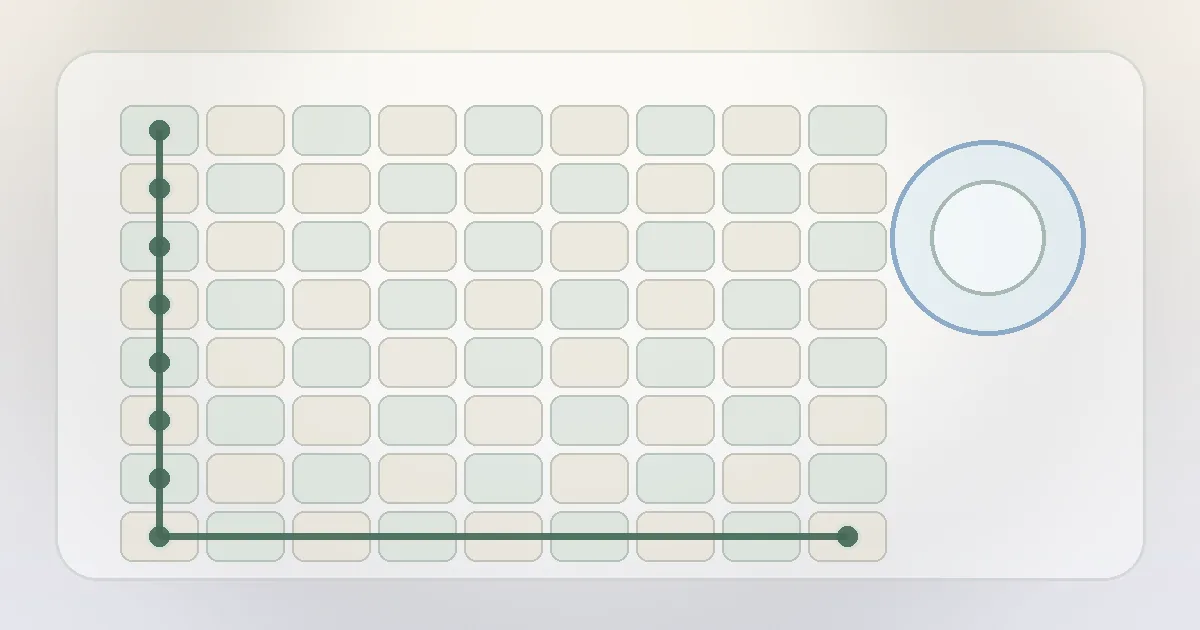
The route represents movement through prompts; the separate circles suggest the reflective work that happens around the move.
The four parts of a Leela session
| Part | Useful function | Common misuse |
|---|---|---|
| Intention | narrows the session to a real decision, pattern, or boundary | asking the board to decide what another person thinks |
| Random move | introduces a topic outside the player’s usual narrative | treating chance as proof |
| Cell | supplies language and questions for examination | reading a label as a verdict |
| Record | preserves facts, reactions, alternatives, and decisions | keeping only the most dramatic interpretation |
The session begins before the die is rolled. Compare “What do I need to clarify before accepting this job?” with “Will the manager choose me?” The first question contains information the player can obtain and actions they can take. The second asks the game to disclose an external outcome. The guide to questions that work for Leela develops this distinction.
Reflecta uses a 72-cell digital board, an entry rule involving a six, and designated transitions. The exact sequence belongs to the chosen ruleset; see the Leela game rules for the reference version and how to play Leela for a first-session walkthrough.
What randomness contributes—and what it does not
Randomness is not a truth mechanism. Its value is that it changes the order in which a person inspects a problem.
Someone who has spent weeks asking “How do I become more motivated?” may reach a cell about boundaries, cost, or agreements. That prompt can reveal a neglected part of the situation: perhaps the task has no defined owner, perhaps the deadline is unrealistic, or perhaps the player is avoiding a necessary refusal. The cell is useful only after comparison with evidence.
A disciplined reading asks:
- Which observable facts are relevant to this theme?
- What is a second plausible interpretation?
- What small test could distinguish between them?
If the theme does not fit, record that result. Forcing every cell to “resonate” creates the illusion of accuracy.
Worked example: a promotion with unclear conditions
Maya is offered a team-lead role. The salary is clear; the responsibilities are not. Her intention is: “What must I understand before I accept?”
She reaches Control. Her first reaction is that fear of change is making her over-control the decision. That is one hypothesis, not the answer. She writes:
Known: salary, starting date, reporting line.
Unknown: team size, hiring authority, success criteria, workload during the transition.
Hypothesis A: she is demanding impossible certainty before taking a reasonable risk.
Hypothesis B: the offer lacks ordinary operational detail, and her concern is appropriate.
Maya sends five questions and asks for the role scope in writing. The reply reveals that she would remain responsible for her old workload for three months. Now she can negotiate or decline on evidence. The cell did not predict whether the promotion would succeed; it helped expose the variable that mattered.
Reading the board as a route, not a ranking
A higher number is not automatically “better,” and a downward transition is not proof of failure. A useful reading keeps five layers separate:
- the current cell number;
- the cell’s base theme;
- any rule-based transition;
- the sequence of previous moves;
- the original intention.
The Leela board guide explains the anatomy of the board, while the 72-cell directory provides a navigable entry point for each theme.
Reflection is different from divination
The difference is visible in the claim being made.
Divinatory claim: “This cell says the relationship will end.”
Reflective claim: “This cell made me list the behaviors I interpret as distance and identify the conversation I have avoided.”
The second statement can be checked, revised, and rejected. The player remains responsible for the decision. Reflecta’s approach treats symbolic material as a prompt rather than an external authority; the distinction is examined in Leela: divination or reflection?.
Historical context without a single-origin myth
Leela is commonly connected to Indian moral and philosophical race games known as Gyan Chaupar. Surviving museum boards differ in layout, number of squares, labels, and transitions. The 72-cell form familiar to many modern players is strongly associated with Harish Johari’s book Leela: The Game of Self-Knowledge.
It is therefore more accurate to distinguish historical families of boards from later standardized or digital adaptations. Reflecta uses its own digital implementation of a 72-cell format. The source trail and unresolved historical claims are set out in the article on the history and origin of Leela.
Questions that suit the method
Leela is most useful when the subject contains room for observation and choice, for example:
- preparing for a difficult conversation;
- examining a recurring work pattern;
- choosing between two acceptable options;
- clarifying a boundary;
- designing a small experiment instead of continuing abstract analysis;
- reviewing a decision after new evidence arrives.
It is a poor tool for questions that require an external fact: “Do I have a medical condition?”, “When will a transfer arrive?”, or “Which investment will rise?” Those questions need diagnosis, documents, calculation, or professional advice.
A quality check after the session
A session has produced usable material when the player can answer:
- What can I now state more precisely?
- Which competing explanations remain open?
- What action is mine, and what evidence will I review?
“Ask for the written role scope by Friday and compare it with my three non-negotiable conditions” is testable. “Trust the universe” may carry personal meaning, but it does not yet specify what will happen next or how the conclusion could be corrected.
Open the Leela board in Reflecta
Use the Leela home screen for a short first session. Write the known facts and your own response before asking the AI guide for a second perspective. The AI can connect the current move with saved notes and propose questions; it cannot observe unrecorded circumstances or make the choice for you.
For a fuller account of the method’s strengths and limits, continue with Leela as a self-discovery game.
Frequently asked questions
Does Leela predict the future?
No. A random move cannot establish a future event. In a reflective use, it introduces a theme that must be compared with evidence and tested through action.
Do I need to believe in the spiritual meaning of the cells?
No. The board can be used as a structured set of prompts. You do not need to accept an interpretation that conflicts with the facts or your experience.
Can I play without a facilitator?
Yes. Solo play works best when the intention is written first, the player answers before seeing AI commentary, and pausing is treated as a valid choice.
Why do different Leela boards have different rules?
Historical and modern boards are not identical. Choose one ruleset before the session and do not switch rules in order to obtain a preferred move.
Must a game reach the final cell?
Not necessarily. A complete-board game and a time-boxed reflection session are different formats. Decide the purpose and stopping condition before attention is exhausted.
FAQ
Does Leela predict the future?
No. A random move cannot establish a future event. In a reflective use, it introduces a theme that must be compared with evidence and tested through action.
Do I need to believe in the spiritual meaning of the cells?
No. The board can be used as a structured set of prompts. You do not need to accept an interpretation that conflicts with the facts or your experience.
Can I play without a facilitator?
Yes. Solo play works best when the intention is written first, the player answers before seeing AI commentary, and pausing is treated as a valid choice.
Why do different Leela boards have different rules?
Historical and modern boards are not identical. Choose one ruleset before the session and do not switch rules in order to obtain a preferred move.
Must a game reach the final cell?
Not necessarily. A complete-board game and a time-boxed reflection session are different formats. Decide the purpose and stopping condition before attention is exhausted.
Sources and editorial method
This material is intended for learning and self-reflection. It does not promise to predict the future and does not replace professional help.