There is no single rulebook shared by every historical board, publication, and online Leela service. A rule explanation must name its version. This page describes Reflecta’s digital implementation: 72 cells, entry on a six, automatic movement, and designated transitions encoded in the board.
Use this as a reference during play. For a beginner sequence with examples, read how to play Leela.
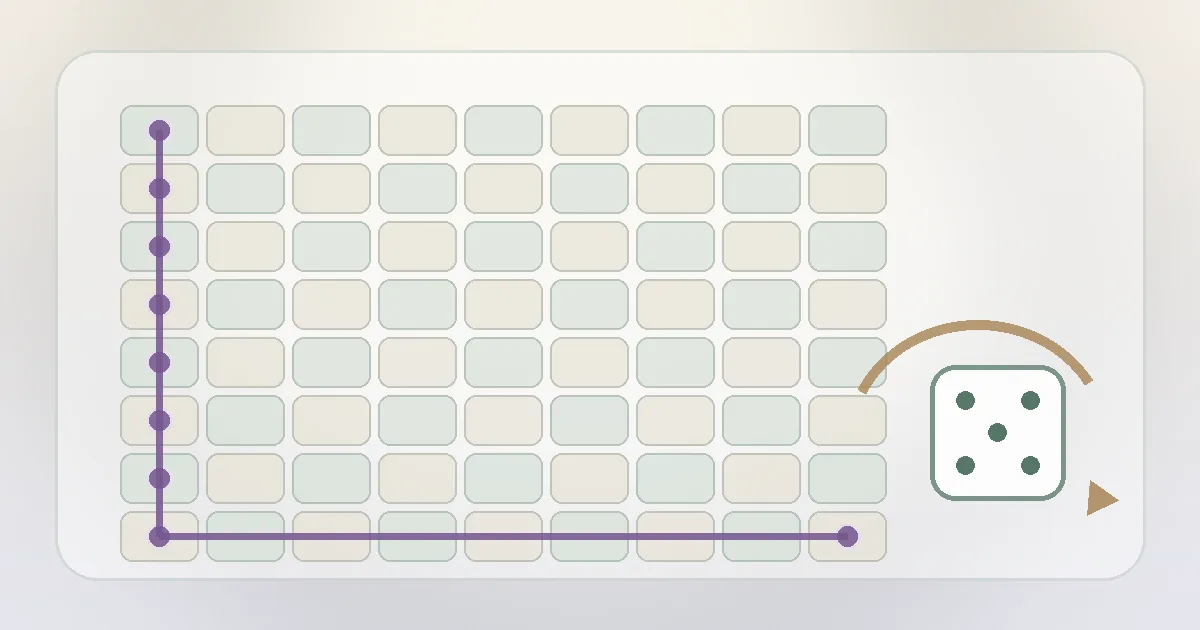
The illustration separates the three mechanical elements: a route, a random roll, and movement that is not rewritten after the fact.
Rules at a glance
| Stage | Reflecta rule | Purpose |
|---|---|---|
| Intention | one personal question is recorded before entry | keeps the session on one subject |
| Entry | the route begins after a six is rolled | provides a common mechanical start |
| Roll | one valid roll per turn | prevents selecting a preferred outcome |
| Movement | the interface calculates the position | avoids manual counting errors |
| Transition | an encoded special route is applied | preserves the map of the selected version |
| Response | the player records their own answer | separates lived context from a ready-made interpretation |
| Turn order | group turns proceed sequentially | prevents disputes over sequence |
| Pause | a session may stop and continue when history is available | protects against exhausted, automatic play |
| Completion | the final note includes an action and a review criterion | moves the outcome beyond the board |
The intention rule
Each participant writes their own subject before the first roll. The question should concern their decision, response, boundary, or action.
Workable: “What do I need to clarify before discussing the division of responsibilities?”
Not workable: “What is my partner hiding from me?”
The second question requires access to another person’s private state. Neither the board nor AI has that access. A responsible reformulation is: “Which observable facts produce distrust, and which conversation am I avoiding?”
Do not replace the intention after an uncomfortable move. A new subject belongs in a separate session; otherwise the cells no longer share a stable context.
Entry on a six
The player rolls until a six appears. The interface then starts movement according to the current implementation.
This rule does not mean:
- the player earned entry;
- a long wait proves a psychological block;
- an immediate six promises an easy game;
- pre-entry numbers carry mandatory messages.
It is a start mechanism. A person may use the waiting period to settle attention, but not to rank themselves.
The sequence of one valid turn
A turn follows this order:
- the active player confirms readiness;
- the die is rolled once;
- the system records the result and calculates the position;
- an encoded transition is applied when present;
- the player reads the theme of the event;
- their own response is saved before AI commentary;
- the turn closes and the sequence continues.
“No connection found” is an acceptable response. The rules do not require invented resonance.
Rerolls and technical failures
A roll cannot be cancelled because:
- the cell is unpleasant;
- the theme has appeared before;
- another number was expected;
- the AI wording was poor;
- the player did not “feel” the result.
A technical failure is different. When the interface displays an error or the roll appears not to have registered, inspect the saved state before creating another result. The move history guide explains which event should be treated as authoritative.
Special transitions
The board contains links that move the piece beyond the number shown by the die. Different descriptions use snakes, arrows, ladders, rises, and falls. In Reflecta, the encoded map of the active version determines the route.
Read the event on two levels:
Mechanically: the source and destination positions.
Reflectively: the question created by placing the two themes side by side.
An upward move is not proof of correctness, and a downward move is not a punishment. Turning the map into a moral score distorts the game. Separate guides cover snakes in Leela and arrows in Leela.
The minimum response after a cell
A useful response includes:
- a specific connection with the original intention;
- one fact that supports the connection;
- an unknown or competing explanation.
Example for Boundary:
Connection: I accept urgent work without renegotiating deadlines. Evidence: three tasks were added after the monthly plan. Alternative: the problem may be the absence of a shared prioritization process rather than an inability to say no. Unknown: whether my manager will agree to a replacement rule.
AI may be used after that note. A more elegant sentence is not automatically a more accurate one.
Group rules: sequence, consent, and privacy
Before opening a room, participants should agree on at least five points:
- who can see each intention;
- which responses may be discussed aloud;
- how long a turn lasts;
- whether public commentary can be declined;
- how a shared pause is called.
Board positions are not levels of development. A player on cell 60 and a player on cell 12 have different routes and different questions—not different human value.
Personal intentions, notes, and AI responses must not be repeated to the group without the author’s consent. A technical privacy control does not remove the need for a human agreement.
A disputed group turn
One participant reaches a cell related to shame and declines to read the response aloud. Others argue that the game requires “complete honesty.”
Under a consent-based rule, the participant may keep the note private or give a neutral acknowledgement. Agreeing to group play is not consent to disclose any personal detail. The turn closes without pressure.
Pausing and resuming
Pause when:
- the planned time has ended;
- answers have become automatic;
- a theme produces an intense reaction;
- an external fact is needed before further interpretation;
- the group can no longer maintain a safe process.
Before leaving, preserve:
- the original intention;
- the current position;
- the last completed turn;
- the unresolved question;
- the condition for return.
For example: “Continue after the contract terms arrive, but not before Friday.” The technical steps are in how to resume an unfinished Leela game.
Completing the session
A full route and a short reflective session may end differently. Both require a written close.
Record:
- one more precise statement of the problem;
- at least two remaining hypotheses;
- information still needed;
- an action within the player’s control;
- a date and evidence for review.
Do not roll “one final time for closure” after attention is gone. Use the existing history. The guide to how long a Leela game takes discusses pacing in more detail.
Why rule sets differ
Historical Gyan Chaupar boards and modern adaptations differ in cell count, labels, links, and completion. Digital products add their own state and privacy mechanics. Do not combine several rule sets inside one game.
Before starting, check:
- the number of cells;
- the entry condition;
- who calculates transitions;
- how history is stored;
- what counts as completion;
- what other participants can see.
The article on different Leela rules compares the main sources of variation.
Rule questions
Can I skip an unpleasant cell?
You may decline a deep public discussion and record a brief response. You should not replace the valid roll with another result.
Which matters more, the cell number or the name?
The number and transition map determine movement; the name contributes a reflective prompt in context. Neither one independently predicts an event.
Is AI commentary required?
No. A concrete personal response is sufficient. AI is optional and should add questions or alternatives rather than authority.
Can I begin a new game before finishing the old one?
Yes, but separate the subjects. Save the first state and explicitly name the new intention.
Where can I use this version?
Open the Leela home screen in Reflecta and confirm the active language and mode before the first roll.
FAQ
Can I skip an unpleasant cell?
You may decline a deep public discussion and record a brief response. You should not replace the valid roll with another result.
Which matters more, the cell number or the name?
The number and transition map determine movement; the name contributes a reflective prompt in context. Neither one independently predicts an event.
Is AI commentary required?
No. A concrete personal response is sufficient. AI is optional and should add questions or alternatives rather than authority.
Can I begin a new game before finishing the old one?
Yes, but separate the subjects. Save the first state and explicitly name the new intention.
Where can I use this version?
Open the Leela home screen in Reflecta and confirm the active language and mode before the first roll.
Sources and editorial method
This material is intended for learning and self-reflection. It does not promise to predict the future and does not replace professional help.