A reference description is always broader than a particular life. Words such as Control, Fear, or Action can fit hundreds of situations, so a feeling of accuracy is not evidence by itself. Interpretation must narrow a broad label into a hypothesis that can be supported, revised, or rejected.
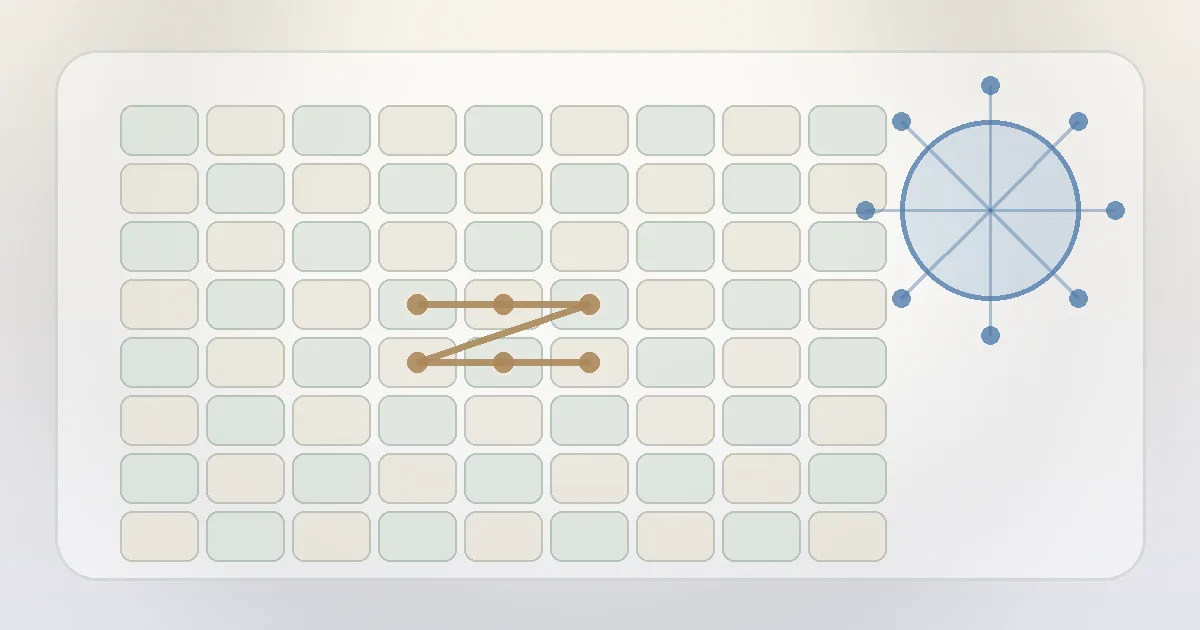
The two routes represent competing explanations; the circular diagram represents context that cannot be recovered from the cell name alone.
Four layers that give a cell practical meaning
The original intention
A cell does not describe the player “in general.” It adds a question to the current subject.
- In a work question, Boundary may concern scope and deadlines.
- In a relationship question, it may concern acceptable communication.
- In a learning question, it may concern time and workload.
If the intention has been lost, stop and open the history. Do not replace it with the cell label.
Observable evidence
An observation can be checked independently:
- the email was sent on Monday;
- the meeting was moved twice;
- the contract contains no deadline;
- the person raised their voice;
- the task took six hours rather than two.
“They do not value me,” “I control everything,” and “he fears intimacy” are interpretations. They may be correct, but they require evidence.
Route context
The source cell, transition, and earlier themes matter. Resource after Exhaustion may raise a different question from Resource after Comparison.
Use the move history guide to reconstruct the sequence.
The player’s response
The first emotional response is data, not the conclusion. Irritation may indicate a significant theme, weak wording, fatigue, or no connection. Separate reaction from explanation:
Reaction: I want to close the description immediately.
Hypothesis: the theme touches an uncomfortable fact.
Alternative: the description is too broad for this intention.
A seven-question interpretation method
A cell does not require an essay. Answer:
- What does the label mean in ordinary language?
- Which part of my intention relates to it?
- Which two facts support that link?
- What contradicts the first interpretation?
- What is a competing explanation?
- Which information is missing?
- Which small test would produce new information?
The last four questions reduce confirmation bias. If the interpretation fits every possible outcome, it explains nothing specific yet.
Example one: Control in a job offer
Intention: “What must I clarify before moving to a new company?”
The dramatic first reading is: “I am trying to control everything because I fear change.” The available evidence is more limited:
- salary and title are known;
- team size and probation criteria are unknown;
- responsibilities were described orally;
- the reply deadline is three days away.
Hypothesis A: the player is demanding certainty where only reasonable risk is possible.
Hypothesis B: the offer lacks ordinary operational detail, and the need for clarity is appropriate.
Distinguishing test: request a written scope and success criteria. If the answers are specific and anxiety remains unchanged, hypothesis A gains support. If the employer avoids detail, hypothesis B gains support.
The cell does not mean “release control.” It creates a question about the line between impossible guarantees and necessary conditions.
Example two: Fear before a conference proposal
Intention: “Why am I postponing my conference submission?”
Evidence:
- the talk topic is selected;
- an abstract draft exists;
- the deadline is ten days away;
- the previous talk had no serious problems;
- the submission form has not been opened.
Possible explanations:
| Hypothesis | Supporting clue | Test |
|---|---|---|
| fear of public evaluation | avoidance begins at submission | show the abstract to two colleagues and request specific feedback |
| uncertainty about format | conference requirements have not been read | open the form and list mandatory fields |
| competing priorities | other work consumes the available time | schedule a 30-minute block and see whether it is completed |
The cell does not diagnose an anxiety disorder. It separates the word “fear” into obstacles that can be checked. Persistent or severe symptoms require appropriate professional support, not a board interpretation.
Example three: Action after a household conflict
Intention: “How can we stop repeating the same conflict about chores?”
The first reaction is: “I should simply do more.” That reading may reinforce the existing imbalance.
Evidence shows that responsibilities were discussed verbally, disputed tasks were never assigned, and both people believe they contribute more. A better interpretation of Action is a small shared experiment:
- list all tasks for seven days;
- assign an owner to each one;
- estimate the time required;
- review the actual week on Sunday;
- adjust the next week’s distribution.
The interpretation produces data rather than an inspirational slogan.
When the cell does not resonate
Mismatch can mean:
- the theme is unrelated to the intention;
- an association exists without evidence;
- the description is too broad;
- the player is tired;
- the connection is possible but information is missing.
Record the specific reason. “I am resisting the truth” is only one hypothesis and usually a poor starting point because it makes the system impossible to challenge. Use what to do when a Leela cell meaning does not resonate for a fuller process.
How to compare a repeated cell
Use four columns:
| First appearance | Later appearance |
|---|---|
| original intention | same or different intention |
| evidence at that date | new events |
| promised action | completed, incomplete, or no longer relevant |
| emotional response | stronger, weaker, or qualitatively different |
If Boundary returns after a conversation, the question may have shifted from “How do I refuse?” to “How do I maintain the agreement?” If the action was never taken, the repeat may simply expose an unfinished test. See repeated cells in Leela.
The appropriate role for AI
After writing your response, ask AI to:
- separate facts from evaluations;
- identify an unstated assumption;
- offer a system explanation alongside a personal one;
- formulate a question for a real conversation;
- design a small reversible test;
- point out what cannot be verified.
Do not ask for the “one true meaning.” The model produces plausible language from the available context. It may miss a critical fact or amplify suggestion. The Leela AI guide limits explain this boundary.
Turn interpretation into an action
A good action:
- is largely under the player’s control;
- has limited scope and time;
- does not require believing the hypothesis in advance;
- produces information;
- can be revised.
Weak: “Completely release control.”
Stronger: “Request written role criteria by Thursday and compare them with three non-negotiable conditions.”
Weak: “Stop being afraid of the stage.”
Stronger: “Open the submission form today, list the fields, and send the abstract to two colleagues.”
Find the current cell
Use the complete directory of 72 Leela cells and open the number recorded in the move history. On the Leela home screen, save your own wording before reading any additional interpretation.
Interpretation questions
Should a cell have a positive and a negative meaning?
It is usually more useful to examine function, risk, and limits. A strict good/bad split encourages pleasant conclusions and hides difficult evidence.
Why do facilitators interpret the same cell differently?
They use different sources, questions, and context. Resolve disagreement by comparing assumptions and evidence, not by selecting the more authoritative voice.
Can the meaning change later?
Yes. New information can change the interpretation. A saved history shows what was revised and why.
How long should one cell take?
Stop when there is a clear connection, a competing explanation, and a test. If the writing becomes more abstract after 10–15 minutes, pause.
FAQ
Should a cell have a positive and a negative meaning?
It is usually more useful to examine function, risk, and limits. A strict good/bad split encourages pleasant conclusions and hides difficult evidence.
Why do facilitators interpret the same cell differently?
They use different sources, questions, and context. Resolve disagreement by comparing assumptions and evidence, not by selecting the more authoritative voice.
Can the meaning change later?
Yes. New information can change the interpretation. A saved history shows what was revised and why.
How long should one cell take?
Stop when there is a clear connection, a competing explanation, and a test. If the writing becomes more abstract after 10–15 minutes, pause.
Sources and editorial method
This material is intended for learning and self-reflection. It does not promise to predict the future and does not replace professional help.