Direct answer — Leela cell 31 “Curiosity”: Curiosity restores an investigative stance instead of a verdict. What question would reveal more than your usual explanation? Write three open questions, choose one that can be tested through observation or conversation, and note what data would change your hypothesis.
Reflecta version: Leela cell 31 “Curiosity” belongs to Reflecta’s digital version; names, numbering, and transitions may differ on other Leela boards.
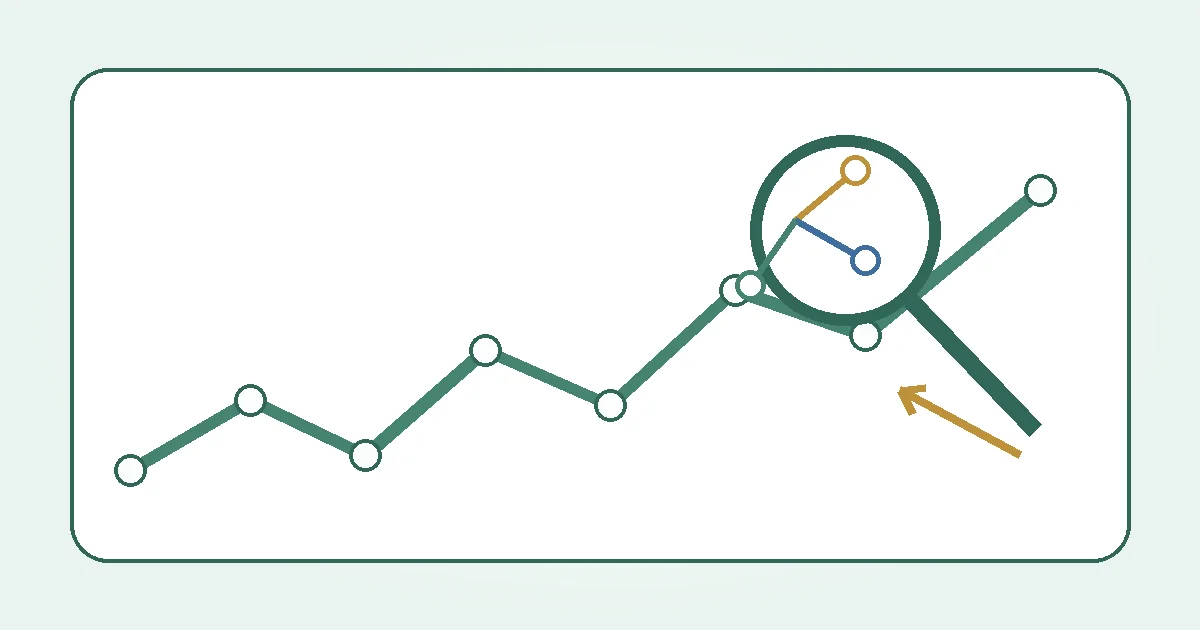
A visual path can organize the sequence of moves without turning it into a forecast.
Leela cell 31 “Curiosity”: how to replace a verdict with a testable question
Curiosity restores an investigative stance when a familiar explanation has already become a verdict. A useful question does more than sound open: it identifies what data to collect, what could change the hypothesis and which decision depends on the answer.
Possible sources
| Aspect | How to use it in your note |
|---|---|
| Known | Facts, dates and observations that can already be checked. |
| Unknown | A specific information gap rather than a general feeling of confusion. |
| Hypotheses | At least two explanations that allow different tests. |
| Test and decision | Which data to collect and what you will do under each result. |
Worked example: Leela cell 31 “Curiosity”
After search traffic falls, a site owner decides that Google has “penalized the whole project.” They write three alternatives: an indexing problem, a demand change or a technical error after an update. Comparing pages, channels and dates reveals an incorrect canonical URL in one section. Curiosity does not remove the problem; it turns a global verdict into a testable task.
Three questions that deepen the answer
- Which familiar explanation have I already treated as fact?
- Which two other hypotheses also fit what is known?
- Which single test offers the most information, and when will I stop researching?
How to check the interpretation
Working question: What question would reveal more than your usual explanation?
Check: the interpretation is useful when at least two competing hypotheses, a data source, evidence that would change the conclusion and a point at which research becomes action are defined.
From reflection to a decision
- Answer the question — What question would reveal more than your usual explanation?
- Set a check — at least two competing hypotheses, a data source, evidence that would change the conclusion and a point at which research becomes action are defined.
- Fix the context — Curiosity restores an investigative stance instead of a verdict. Read it together with the intention, the events before the move and the answers already recorded. Write your own response before opening an AI interpretation.
- Choose an action — Write three open questions, choose one that can be tested through observation or conversation, and note what data would change your hypothesis.
For the wider game context, see Leela board guide: cells, movement, and transitions.
An important qualification
The return to cell 16 “Responsibility” can be read as a reminder that a question is useful when the player accepts responsibility for the test and the later decision. It is a Reflecta route rule, not a judgment of character.
On the current Reflecta board, this cell returns to cell 16 “Responsibility”; this is a board rule, not a punishment or prediction. After your own answer, an optional symbolic tool is available. A movement or extra option on the Reflecta board is a rule of this version, not proof that the same outcome will occur in life.
Misreadings that weaken the result
- asking new questions without a sufficiency rule and calling it research while the decision is postponed indefinitely.
- copying the AI summary before writing your own answer.
- turning “Curiosity” into a permanent personality label.
- using the cell to guess another person’s hidden motives.
Questions and answers
Can curiosity become a way to avoid making a decision?
Yes. Endless questions and data collection can protect you from choosing. Set a deadline, a sufficient evidence threshold and the decision that will follow the check.
Does this cell predict what will happen?
No. The “Curiosity” cell can help form a hypothesis, but it does not reveal another person’s thoughts or prove an inevitable future.
What can the AI guide add?
AI can compare the response to the “Curiosity” theme with earlier moves, point out a contradiction and ask a clarifying question. It cannot verify unrecorded facts or decide for the player.
What makes a useful question different from an attractive abstract one?
A useful question connects to observable data and can change an action. If no possible answer affects the decision, the question is probably too broad.
Related Leela guides
Use the following guides to place this cell in the wider logic of the game:
- Questions that work for Leela: formulas focused on your influence
- How AI analyses a player’s answers in Leela
- A Leela cell meaning does not resonate: what to do
- Leela board guide: cells, movement, and transitions
- Leela 72 cells: reading the path without fatalism
- Leela cell meanings: contextual interpretation without templates
- Leela cell 37 “Consequence”: meaning and questions
- Leela cell 39 “Forgiveness”: meaning and questions
Save your note and continue in Reflecta Leela. Treat the AI response as a hypothesis to test, not as a decision made for you.
FAQ
Can curiosity become a way to avoid making a decision?
Yes. Endless questions and data collection can protect you from choosing. Set a deadline, a sufficient evidence threshold and the decision that will follow the check.
What makes a useful question different from an attractive abstract one?
A useful question connects to observable data and can change an action. If no possible answer affects the decision, the question is probably too broad.
Does this cell predict what will happen?
No. The “Curiosity” cell can help form a hypothesis, but it does not reveal another person’s thoughts or prove an inevitable future.
What can the AI guide add?
AI can compare the response to the “Curiosity” theme with earlier moves, point out a contradiction and ask a clarifying question. It cannot verify unrecorded facts or decide for the player.
Sources and editorial method
This material is intended for learning and self-reflection. It does not promise to predict the future and does not replace professional help.