Because the Leela board resembles a path, it is easy to read it as a ladder from “lower” states to “higher” ones. That reading creates an avoidable problem: players begin judging themselves by cell number and assigning moral value to movement. Reflecta uses the board as a map of prompts, transitions, and written context—not as a score of personal development.
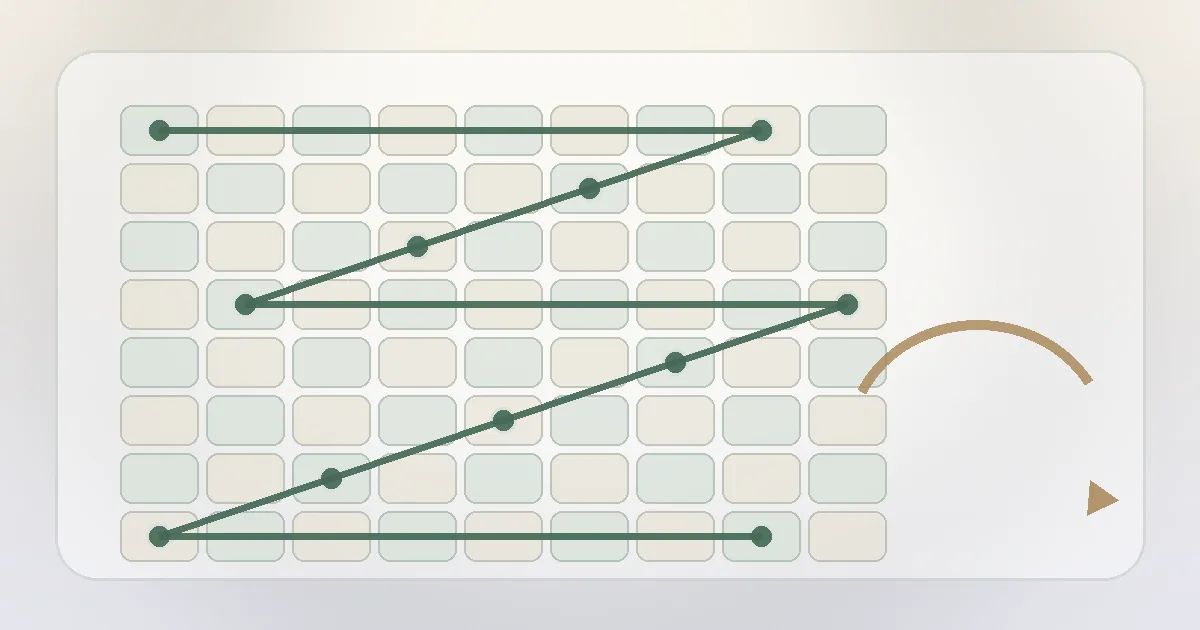
The horizontal and diagonal lines show that the route includes both counted movement and encoded links between selected cells.
The information contained in a board event
| Layer | What is recorded | Appropriate use |
|---|---|---|
| Cell number | a position from 1 to 72 | reconstruct movement and sequence |
| Cell name | a base theme such as Boundary or Risk | ask questions within the intention |
| Ordinary move | movement by the die result | preserve the mechanical cause of the position |
| Special transition | a link between two cells | compare the source and destination themes |
| History | earlier positions and responses | notice repetition, revision, and failed hypotheses |
| Personal intention | the subject of the current session | prevent one cell from becoming a claim about the whole life |
Reading only the label is the most common shortcut. Fear during a public-speaking question requires different evidence and action from Fear during a contract review.
Why this version has 72 cells
Reflecta uses a 72-cell model associated with the widely known modern version by Harish Johari. It sits within a broader history of Indian Gyan Chaupar games, but surviving boards differ in square count, labels, and routes. Seventy-two therefore describes the selected implementation, not every historical form.
Use the directory of all 72 Leela cells to navigate to an individual theme and its practical question.
How movement is represented
After entry, the player receives a die result and the interface calculates the next position. When the cell has an encoded link, the transition is applied. The player does not need to count manually or choose a direction.
Retain more than the destination. A move may be represented as:
Roll: 4
Starting position: 18 Perspective
Counted position: 22 Comparison
Transition: 22 → 13 Desire
Mechanically, this is one turn with several stages. Reflectively, it creates a possible question: Do I want this result, or am I measuring myself against someone else’s path?
Entry and movement rules are listed in the Leela game rules.
Snakes, arrows, rises, and falls
Different boards draw special routes in different ways. The words “snake” and “arrow” can identify the route, but they should not automatically become moral judgments.
Unhelpful: “The arrow lifted me, so my interpretation was correct.”
Useful: “The route connected two themes. Which observable connection exists in my question?”
Unhelpful: “The snake sent me down because I failed a lesson.”
Useful: “Which condition or habit returns this situation to an earlier theme, and what evidence supports that?”
See snakes in Leela and arrows in Leela for focused explanations.
Read the current position from evidence outward
Return to the original question
Do not ask “What does cell 36 mean in general?” Ask “What does Agreement add to my question about shared household responsibilities?”
List the facts
- the responsibilities were discussed once;
- no list was recorded;
- two tasks are assumed to belong to the other person;
- the same conflict occurred three times.
Keep at least two hypotheses
Hypothesis A: the problem is the absence of an explicit agreement.
Hypothesis B: an agreement exists, but one person repeatedly does not follow it.
Identify distinguishing evidence
Is there a written list? Do both people remember the same agreement? What happened after earlier discussions?
Choose an action
Create a one-week list, assign disputed tasks, and schedule a 15-minute review on Sunday.
The cell now contributes to an investigation rather than labeling the relationship.
A route contains more information than an isolated cell
A sequence can reveal:
- related themes returning;
- the intention changing without acknowledgement;
- the same problem reappearing after an action was not completed;
- new evidence altering the interpretation;
- earlier readings that did not hold up.
Consider Boundary → Agreement → Repetition → Action. The chain does not prove a hidden message in the board. It may, however, prompt a useful audit: a boundary was named and an agreement was made, but the old pattern returned. The next question concerns enforcement, feedback, or system design rather than awareness alone.
Use the move history guide for longer sessions and what to do when a cell repeats for recurrence.
The board is not a ranking system
Position cannot establish who is:
- more psychologically mature;
- more spiritually developed;
- giving the “right” answers;
- likely to change faster;
- deserving of a better outcome.
This matters in group play. “I am on cell 64 and you are on cell 17” compares different routes and intentions, not personal worth.
The external resemblance to Snakes and Ladders does not create the same purpose. See Leela versus Snakes and Ladders for the distinction.
When an individual cell page is useful
Open a cell article when you need to:
- clarify the base meaning of a term;
- find questions rather than a prediction;
- compare two plausible connections;
- see an example of a practical test;
- understand why the theme may not resonate.
The directory does not override context. When a generic description conflicts with the evidence, the evidence takes priority. The method is developed in how to interpret Leela cell meanings.
What the visual board can and cannot show
The board image can help answer:
- where the piece is;
- which route has been travelled;
- where a transition began;
- which cells repeated;
- how many events occurred between two themes.
It cannot demonstrate psychological causation. A line drawn between two cells is a game rule, not proof that one internal state objectively causes another.
Open the board and inspect the route
The Leela home screen displays the current position in the digital route. Before playing, write the question. After a transition, preserve the source, the link, and the destination as separate facts. That record remains useful even if the first interpretation changes.
Board questions
Is the upper part of the board more spiritual?
Some traditions may use hierarchical language, but Reflecta does not use position as a character score. Every theme is evaluated against the intention and evidence.
Can the board be wrong?
The board can execute its encoded movement correctly while a human or AI interpretation is wrong or irrelevant. Record mismatches rather than hiding them.
Why are selected cells connected?
The links belong to the chosen map. Historical and modern versions encode different relationships; one game uses the active board consistently.
Is studying the board image the same as playing?
No. The image explains structure. Reflective value requires a specific intention, a sequence, and the player’s own written response.
FAQ
Is the upper part of the board more spiritual?
Some traditions may use hierarchical language, but Reflecta does not use position as a character score. Every theme is evaluated against the intention and evidence.
Can the board be wrong?
The board can execute its encoded movement correctly while a human or AI interpretation is wrong or irrelevant. Record mismatches rather than hiding them.
Why are selected cells connected?
The links belong to the chosen map. Historical and modern versions encode different relationships; one game uses the active board consistently.
Is studying the board image the same as playing?
No. The image explains structure. Reflective value requires a specific intention, a sequence, and the player’s own written response.
Sources and editorial method
This material is intended for learning and self-reflection. It does not promise to predict the future and does not replace professional help.