This directory is designed for navigation, not divination by number. Find the cell recorded in the move history, open its focused page, and choose the question that fits the current situation. There is no need to apply every prompt.
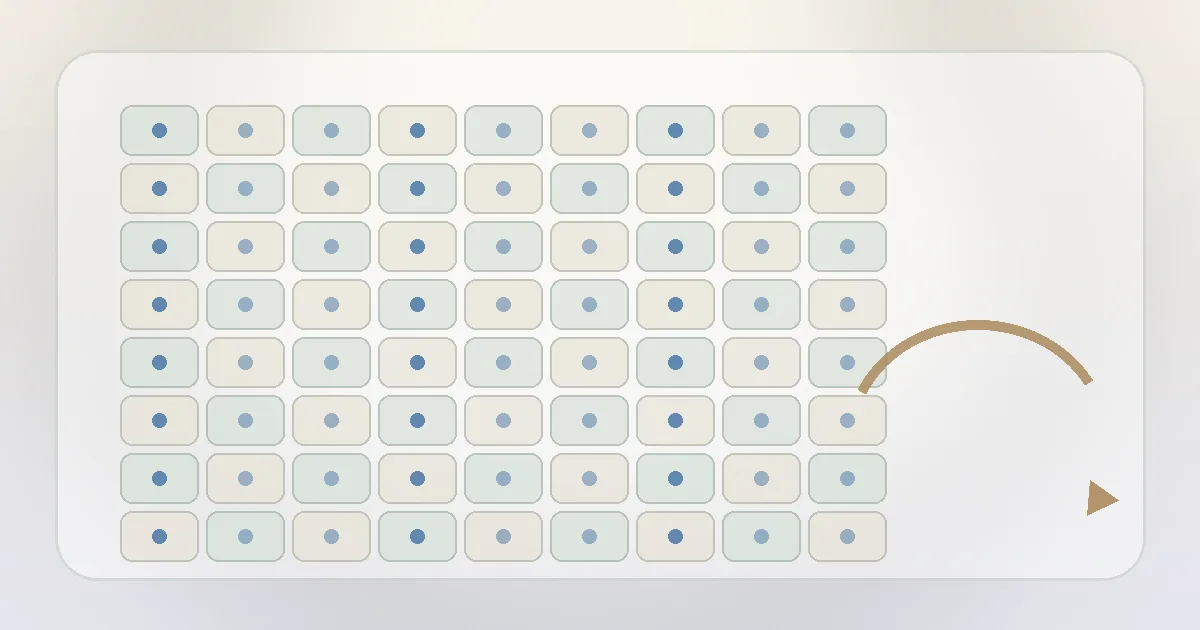
Each dot represents a separate theme. The movement arc is a reminder that the cell belongs to a route rather than functioning as an isolated answer.
How to use the directory
- Match the number with the recorded move.
- Return to the original intention.
- Open the cell page and select one or two questions.
- Write one concrete fact that supports the connection.
- Add a competing explanation or record that no connection was found.
- Decide whether another move is needed or the session already has enough material for action.
The list below documents Reflecta’s editorial system. It does not claim that every historical board used these labels. Museum Gyan Chaupar boards and modern implementations vary, so always identify the version before comparing sources.
Cells 1–12: enter the situation and separate fact from story
The opening themes establish the frame: what the player brings, what is known, and where facts end and expectation, impulse, or resistance begins.
- Entry — What question am I actually bringing into the game?
- Fact — What happened without my explanation or judgment?
- Expectation — What outcome am I demanding in advance?
- Choice — Which part of the choice genuinely belongs to me?
- Boundary — Where are my yes and my no?
- Pause — What may become clearer if I do not act immediately?
- Doubt — What information is missing from the decision?
- Support — What can I rely on already?
- Honesty — What do I know but avoid stating clearly?
- Impulse — What is pushing me to act now?
- Resistance — What am I avoiding, and what am I protecting?
- Clarity — How can I describe the situation in one precise sentence?
Cells 13–24: desire, responsibility, and other people
This section turns toward motives, control, trust, habits, and exchange. Avoid assigning private thoughts to people whose inner state cannot be observed.
- Desire — What do I want when other people’s expectations are removed?
- Control — What am I trying to control outside my authority?
- Resource — Which resource is available, and how can I measure it?
- Responsibility — Which part of the outcome is mine to own?
- Trust — What can be checked before trust is extended?
- Perspective — How does the situation look from another position?
- Vulnerability — What am I protecting, and why does it matter?
- Habit — Which automatic pattern keeps repeating?
- Conversation — Which conversation am I postponing?
- Comparison — Who or what am I measuring myself against?
- Exchange — What am I giving, and what am I receiving?
- Resolve — Which decision is already becoming clear?
Cells 25–36: body signals, emotion, risk, and agreement
These cells can produce a strong reaction. Read them specifically: an emotion can indicate an experience or need, but it is not a diagnosis or proof of another person’s intention.
- Body — What is the body reporting without turning it into a diagnosis?
- Role — Which role am I playing, and can it change?
- Shame — Which fear of judgment is shaping my behavior?
- Anger — Which boundary or need is anger pointing toward?
- Sadness — Which loss needs to be acknowledged?
- Fear — Which specific risk can be tested?
- Curiosity — What still produces genuine interest?
- Acceptance — What already exists and will not change today?
- Value — What matters more than convenience?
- Intention — Which outcome depends on my actions?
- Risk — What is the worst realistic scenario, and what protects against it?
- Agreement — What must be named, agreed, and recorded?
Cells 37–48: consequences, repetition, shadow, and cost
This range supports a review of what follows a choice, which pattern repeats, and which cost is already being created by action or inaction.
- Consequence — What will continued inaction produce?
- Assistance — Who can help, and what exactly will I ask for?
- Forgiveness — What can be released without abandoning boundaries?
- Repetition — What repeats, and under which conditions?
- Witness — What do I notice when I stop intervening?
- Scale — Am I turning one detail into the whole picture?
- Image — Which image of myself am I trying to preserve?
- Shadow — Which quality do I acknowledge only in other people?
- Contradiction — Which two truths are colliding?
- Refusal — What needs a clear no without hidden negotiation?
- Consent — What am I genuinely agreeing to?
- Cost — Which cost am I already paying?
Cells 49–60: pace, experiment, and system change
The emphasis shifts from interpretation to testing: choose a sustainable rhythm, identify a skill or ally, define influence, and collect feedback.
- Rhythm — Which pace can be sustained?
- Experiment — How can I test the hypothesis with a small step?
- Skill — Which skill is missing rather than “motivation”?
- Ally — Who can help without taking over?
- System — Which rules in the environment keep the problem in place?
- Influence — What can I influence directly, indirectly, or not at all?
- Uncertainty — What remains unknown?
- Patience — What needs time rather than more pressure?
- Action — What next step takes less than thirty minutes?
- Feedback — Which data will show the result?
- Adjustment — What should change after the first evidence?
- Release — What can I stop holding?
Cells 61–72: integration, agency, and completion
The final range does not guarantee enlightenment. It helps preserve what works, reclaim authorship, complete an obligation, and compare the conclusion with reality.
- Gratitude — What is already working and should be preserved?
- Integration — How can the conclusions be combined without false agreement?
- Agency — Which choice will I stop delegating to others?
- Balance — Where is one important area crowding out another?
- Meaning — Why does this step matter to me?
- Freedom — What does freedom with responsibility look like?
- Presence — What is happening right now?
- Completion — What is sufficient to finish rather than endlessly improve?
- Commitment — Which promise am I actually prepared to keep?
- Review — What must be checked against reality?
- Exit — How can I leave without an unclosed obligation?
- Wholeness — Which parts of the decision need to fit together?
Reading two consecutive cells
Numerical adjacency does not prove psychological causation. It provides route order. When a player moves through Expectation → Choice, a useful question may be: Which preselected outcome is narrowing my choice? Keep the alternative open: the pair may not create a meaningful connection.
For a special transition, preserve both points. The guides to snakes and arrows explain these links without reward-and-punishment language.
When the same cell appears again
Repetition does not have to mean an “unlearned lesson.” Compare the dated records:
- Is the intention the same?
- Has new evidence appeared?
- Was the earlier action completed?
- Has the emotional response changed?
- Are the same words describing a different situation?
See repeated cells in Leela for a structured comparison.
When the description does not fit
A general article cannot know the session context. Three outcomes are valid:
- the connection is supported by evidence;
- the connection remains a hypothesis;
- no connection is found.
Do not repair the third result with an impressive story. The article on what to do when a Leela cell meaning does not resonate provides a more detailed method.
Directory versus interpretation method
This page answers “Where is the cell I need?” The guide to interpreting Leela cell meanings answers a different question: “How do I turn a broad description into a testable hypothesis without using a fixed template?”
Start the route
Open Leela in Reflecta, write the intention, and return to the matching directory entry after the first significant move. A short session can end after one cell when it produces a clear question and action.
Questions about the 72 cells
Should I read every cell before playing?
No. Doing so may create expectations and encourage matching the game to preferred themes. Use the directory after a move or when studying board structure.
Which cell is the most important?
The one that helps examine the current intention more precisely. Number, position, and emotional intensity do not create a universal hierarchy.
Can I choose a cell without rolling?
For a journaling exercise, yes—provided you state that you are choosing a topic. During a Leela game, follow the active board rules rather than replacing a random move with manual selection.
FAQ
Should I read every cell before playing?
No. Doing so may create expectations and encourage matching the game to preferred themes. Use the directory after a move or when studying board structure.
Which cell is the most important?
The one that helps examine the current intention more precisely. Number, position, and emotional intensity do not create a universal hierarchy.
Can I choose a cell without rolling?
For a journaling exercise, yes—provided you state that you are choosing a topic. During a Leela game, follow the active board rules rather than replacing a random move with manual selection.
Sources and editorial method
This material is intended for learning and self-reflection. It does not promise to predict the future and does not replace professional help.