A first Leela game often becomes unhelpful because the player expects one evening to settle work, relationships, and the future at once. A better first session stays with one question and ends when there is enough material for a real-world next step.
The sequence below is designed for solo play in Reflecta. It keeps game mechanics and interpretation separate: make the move, write the response, and only then request additional commentary.
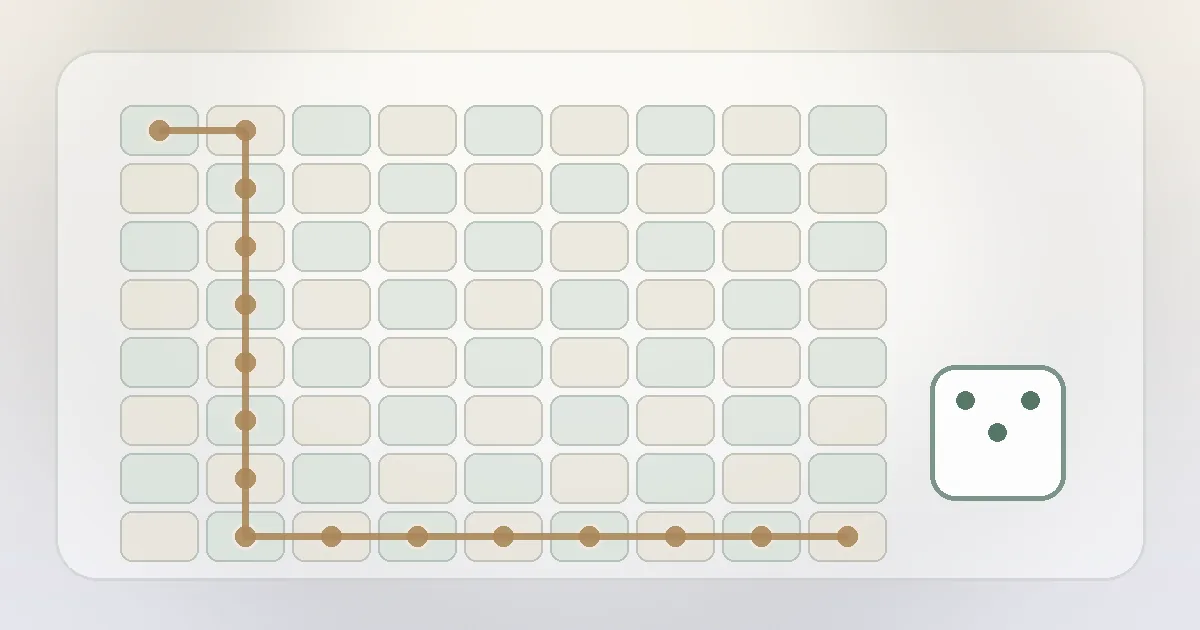
The route shows ordered movement; the die selects the next topic. Neither one supplies the player’s conclusion.
Prepare one workable subject before rolling
Open a note and complete four lines:
Situation:
My question:
Three known facts:
A useful outcome from this session:
Example:
Situation: I have postponed publishing my portfolio for three months.
My question: What exactly is preventing me from showing finished work to potential clients?
Facts: five projects are selected; the profile text is unfinished; I moved the date four times.
Useful outcome: identify one barrier and one action for the next 48 hours.
“When will I become successful?” has no practical boundary. It permits endless interpretation and no review criterion. The article on questions that work for Leela provides more precise alternatives.
Choose the session length in advance
A beginner can use one of three formats:
| Format | Typical length | Best use |
|---|---|---|
| One significant move | 10–15 minutes | clarify the question or interrupt a stuck narrative |
| Short sequence | 25–40 minutes | compare several connected themes |
| Full game | no fixed duration | use when you have experience, energy, and room for breaks |
Set the stopping time before the game. A pause then becomes part of the plan rather than evidence of failure. The first-game preparation guide covers space, pacing, and emotional readiness.
Open the board and enter the route
Go to the Leela screen in Reflecta. In this version, entry occurs when a six is rolled. That is a mechanical condition, not a test of spiritual readiness. Five unsuccessful rolls do not mean resistance, a block, or a prohibition.
Do not change the intention while waiting or assign a hidden message to every number. You may note frustration, but it is not compulsory evidence about the life situation.
After entry, move by the die result. Do not reroll because a cell name feels uncomfortable. If the interface applies a transition, preserve both parts of the event: the original cell and the destination. The reference details are listed in the Leela game rules.
Use a five-question note after each move
Before reading AI commentary, answer:
- What is the cell called?
- What was my first association?
- Which fact from the situation connects with it?
- What is another explanation?
- What remains unknown?
Suppose the portfolio player reaches Image.
First association: “I want to appear flawless.”
Relevant fact: two projects remain unpublished because of small edits nobody requested.
Alternative: the obstacle may be an undefined publishing workflow rather than perfectionism.
Unknown: how long it would actually take to upload and describe the five projects.
Now the cell description or AI response has something to work against. The player’s own thinking is already on the page.
Read a transition without turning it into a reward or punishment
A transition changes the board position. It does not rank the player.
Keep two notes:
- what the source cell raised;
- what new question the destination adds.
If Image leads to Honesty, a useful connection might be: Which public image am I protecting, and what would be more honest to admit? Another valid result is that the pair does not fit the situation. The Leela board guide explains how routes and transitions are represented.
Complete first-session example
Return to the delayed portfolio.
Starting point
The work exists, but the publication date keeps moving. The session aims to identify a barrier that can be tested.
Significant move one: Image
Hypothesis: the player is trying to publish an ideal professional identity rather than a useful sample of work.
Alternative: the technical sequence for publication is missing.
Significant move two: Risk
Instead of writing “fear of judgment,” the player names realistic risks:
- some people will not reply;
- one project may appear weaker than expected;
- the portfolio will need revision later.
None of these outcomes is catastrophic. The worst plausible result is several rejections and replacing one project.
Significant move three: Action
The conclusion becomes operational:
- create a draft page;
- upload the three strongest projects;
- send the private link to one designer;
- fix only errors that block understanding;
- publish by 6 p.m. the next day.
Review criterion
Within 48 hours, the page opens publicly and has been sent to at least two potential clients. If that does not happen, the player reviews which step stopped—without rerolling the board to obtain a better message.
This is a complete reflective loop: the cells helped form hypotheses, while behavior and external evidence judge the result.
Ask AI questions that preserve your agency
Useful prompts include:
- “Identify two assumptions in my note.”
- “Offer an explanation that is not based on a personal defect.”
- “What evidence would distinguish these two hypotheses?”
- “Reduce my conclusion to one testable sentence.”
- “Which information is still missing?”
Avoid “Tell me what to do” and “What does the cell really mean?” The model sees text, not your unrecorded life. It can edit the inquiry; it cannot own the choice.
Decide whether the next move still serves the question
Continue when:
- the previous response is written;
- you can connect it to the original intention;
- the emotional load remains manageable;
- the new roll is for exploration, not cancellation of an uncomfortable result.
Pause if answers become automatic, the question is forgotten, or you want to roll until a “good” cell appears. The guide to what happens after each Leela move suggests a sustainable rhythm.
End with a reviewable record
Complete this closing note:
What became clearer:
Which hypotheses remain open:
Next action:
Deadline:
Evidence of progress:
What I will reconsider if the action fails:
Keep cells that did not resonate as well as those that did. Mismatches make later review more honest. For a longer game, follow the Leela progress-saving guide.
Beginner errors that are easy to correct
Changing the intention after every cell. The record loses its subject.
Reading AI before writing. Fluent text becomes an anchor.
Treating upward movement as success and downward movement as failure. Position is not a character score.
Explaining everything symbolically. Decisions still require conversations, documents, and evidence outside the board.
Continuing through fatigue. More cells do not automatically create a better session.
First-game questions
Do I need to know all 72 cell meanings?
No. Read the current cell in context. The directory is a navigation aid, not a vocabulary test.
What if a cell does not fit at all?
Write “no connection found” and explain why. Do not manufacture resonance. A connection may appear later, or the cell may remain irrelevant.
Can I play only one move?
Yes. One well-examined move may be more useful than a fast sequence without notes.
Should I repeat the same question in another game?
Repeat it after new evidence or after completing the previous action. Restarting immediately after an unwelcome result usually searches for a preferred interpretation.
Where can I read the basic definition first?
Start with what the Leela game is and how it works, then use the rules for the exact version you are playing.
FAQ
Do I need to know all 72 cell meanings?
No. Read the current cell in context. The directory is a navigation aid, not a vocabulary test.
What if a cell does not fit at all?
Write “no connection found” and explain why. Do not manufacture resonance. A connection may appear later, or the cell may remain irrelevant.
Can I play only one move?
Yes. One well-examined move may be more useful than a fast sequence without notes.
Should I repeat the same question in another game?
Repeat it after new evidence or after completing the previous action. Restarting immediately after an unwelcome result usually searches for a preferred interpretation.
Where can I read the basic definition first?
Start with what the Leela game is and how it works, then use the rules for the exact version you are playing.
Sources and editorial method
This material is intended for learning and self-reflection. It does not promise to predict the future and does not replace professional help.