Direct answer: After a Leela move, place the token and complete any board transition, then read the theme and question of the final cell. Before rolling again, write your own answer, connect it to the original intention, and identify one fact that supports or challenges the idea. AI or facilitator input comes after the personal response, not instead of it.
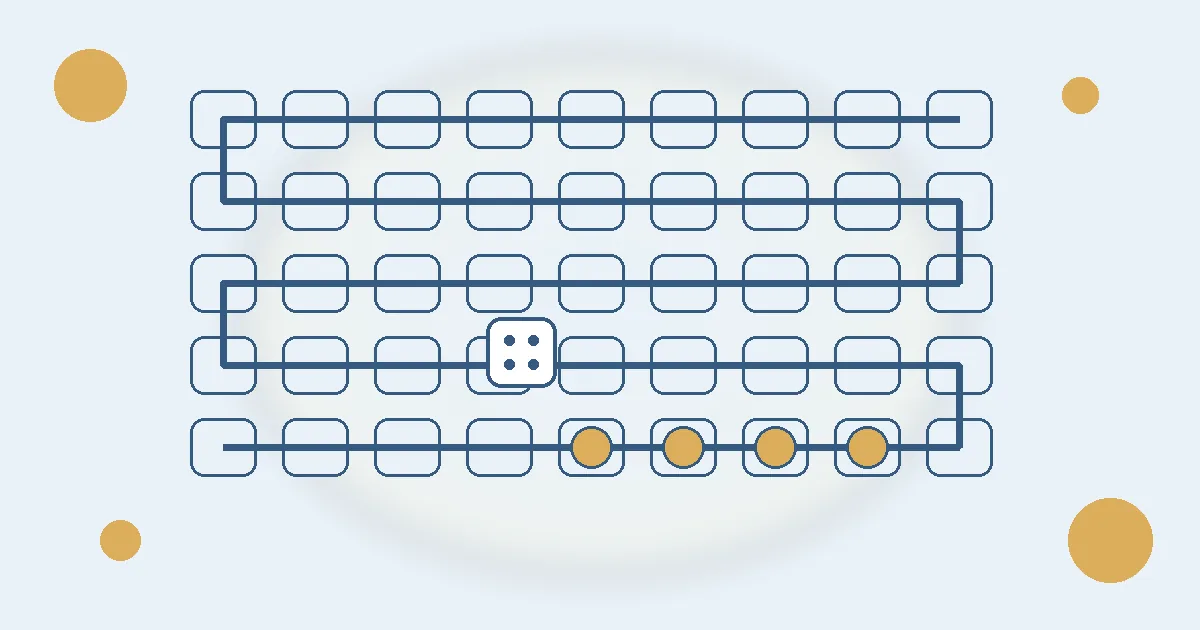
A move is more than a die roll
The die handles navigation. The reflective work starts after the token has moved. Keep two layers separate: what happened on the board and what you noticed in the real situation. When they are merged, a random number can start to sound like a conclusion.
Reconstruct the route first
Record four items: the number rolled, the starting cell, any arrow or snake, and the final cell. Do not rush to a positive or negative meaning. The mechanics only determine where the move ends.
Read the question, not just the cell name
A title gives a broad theme; the question connects it with the intention. “This is about fear” is too vague. A useful note is more specific: “I am delaying the conversation because I have not requested the terms in writing and I am imagining the manager’s reaction.”
The ninety-second pause
After a meaningful move, work through five prompts:
- Fact: what has already happened and can be verified?
- Reaction: what did I feel or want to do when I saw the cell?
- Hypothesis: what connection with the intention am I proposing?
- Alternative: what other explanation is equally plausible?
- Step: what small action would produce a new fact?
The pause need not last exactly ninety seconds. Its purpose is to interrupt automatic rolling.
Example: deciding whether to change jobs
A player asks what is blocking a decision about a new role. The move ends on a cell associated with attachment. The first reaction is, “The game says I am clinging to my old job.”
A fact check changes the wording. There is no written offer yet, and the player is worried about the probation period. An alternative hypothesis is that the problem is missing information rather than attachment. The next step is to request the terms and compare them with criteria written before the game. The cell did not choose a job; it exposed a missing fact.
When is the move complete?
A move is complete when you can state its connection with the intention in one sentence and name what you will verify. Not every cell needs to produce a profound insight. “I do not see a reliable connection yet” is a valid entry and is better than inventing a convincing story after the fact.
Strong emotion, fatigue, or the urge to reroll for a different result are good reasons to stop. A pause does not break the game; it protects the quality of attention.
Questions about this topic
Which cell should I read after an arrow or snake?
Read the final cell, but keep both positions in the history. The starting cell shows where the transition began; the destination supplies the theme for the next part of the game.
Do I have to write an answer to every cell?
Writing is not a universal rule, but it prevents later guidance from replacing your first response and makes the move history useful.
Can I roll again immediately?
You can, but a fast sequence turns the cells into decoration. Leave at least one concrete answer and one relevant fact before the next roll.
When should I ask the AI guide?
After your own answer. Then the prompt can be compared with your view instead of becoming a ready-made decision.
Related Leela guides
- How to play Leela: a step-by-step guide for a first game
- Leela game rules: entry, moves, transitions, and completion
- Leela move history
- What a repeated cell means in Leela
- What arrows mean in Leela
- What snakes mean in Leela
- Leela with an AI guide: how the full history of moves is used
- How to resume an unfinished Leela game
FAQ
Which cell should I read after an arrow or snake?
Read the final cell, but keep both positions in the history. The starting cell shows where the transition began; the destination supplies the theme for the next part of the game.
Do I have to write an answer to every cell?
Writing is not a universal rule, but it prevents later guidance from replacing your first response and makes the move history useful.
Can I roll again immediately?
You can, but a fast sequence turns the cells into decoration. Leave at least one concrete answer and one relevant fact before the next roll.
When should I ask the AI guide?
After your own answer. Then the prompt can be compared with your view instead of becoming a ready-made decision.
Sources and editorial method
This material is intended for learning and self-reflection. It does not promise to predict the future and does not replace professional help.