Read a natal chart from the broad structure toward the details. Verify the date, time, and place of birth; establish the Sun, Moon, and Ascendant; connect each planet with its sign and house; and use aspects to refine how the functions interact. The aim is to build one coherent hypothesis from repeated themes, not to label every symbol separately.
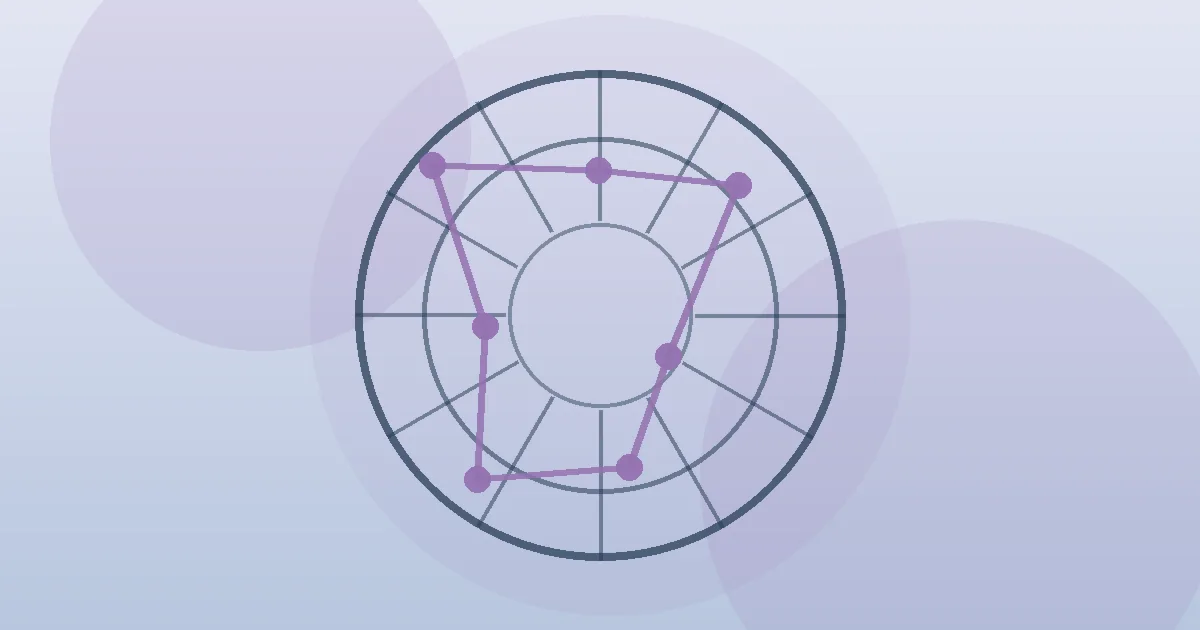
Method map: natal chart
The date sets the planetary positions. Place and time zone are needed for the local house framework, while the exact time is especially important for the Ascendant and house cusps. When the time is unknown or approximate, avoid confident statements about houses and chart angles. Record the limitation explicitly. The Sun is commonly read as conscious direction and the way a person develops a stable sense of purpose.
Also compare this layer with the core query “natal chart”. The Moon describes habitual emotional responses and ways of restoring balance. The Ascendant represents the style of entering situations and meeting the outside world. Do not turn them into three isolated labels.
What forms the result for “natal chart”
A planet describes what function is active, a sign shows how it tends to operate, and a house indicates where the theme becomes visible. Mars in the same sign will be expressed differently in a house connected with work, relationships, or creativity. Start with the personal planets: Sun, Moon, Mercury, Venus, and Mars. Add the social and outer planets when they connect with chart angles, personal planets, or a theme that already repeats. A useful formula is planet = what function acts, sign = how it acts, house = where it becomes visible.
The sign on the cusp gives the house a style, while its ruler connects that area to another part of the chart. No placement should be read alone; aspects, repeated themes, and the reliability of the birth data determine how much weight it deserves. A planetary placement should not be reduced to a single adjective. Use the sequence planet = what acts; sign = how; house = where; aspects = how it cooperates or conflicts with other functions. Then look for repetition elsewhere in the chart.
Mars in one sign does not define an entire temperament, and Venus alone does not describe every relationship.
First reading: natal chart
A strong summary has three parts: the repeated theme, the condition that activates it, and an observable action. For example: “Several placements repeat a need to understand the structure before acting. Under uncertainty, the start may be delayed. A useful practice is to define a minimum viable decision and a date for review.” Treat this as a hypothesis for observation, not a permanent verdict on personality.
Application example: natal chart
The example below turns “natal chart” from a broad meaning into a testable action. Imagine Mars in the sixth house, with the sixth-house ruler in the tenth. “This person is a workaholic” is too rigid. A better hypothesis is that energy is mobilised by concrete tasks, process improvement, and visible professional progress. The test is whether the person can sustain that drive without overload and define when a task is complete.
Mistakes when using “natal chart”
Before concluding, check the mistakes that most often distort work with “natal chart”:
- reading only the Sun sign
- interpreting one placement without context
- treating empty houses as negative
- listing meanings without a synthesis
- ignoring an uncertain birth time
- using the chart as proof of compatibility, diagnosis, or a future event
- reading a planet without its sign, house, and aspects
Interpretive limits: natal chart
For “natal chart”, separate interpretive use from decisions that require factual or professional evidence. House cusps depend on birth time, location, and historical time zone. If the time is unknown, the Ascendant and houses should not be presented as certain. Placidus, Whole Sign, and other systems can also place the same planet in different houses. Choose one method, name it, and avoid silently mixing interpretations.
Save the conclusion as a testable hypothesis and review it after the chosen action.
Practical protocol: natal chart
Use a short, repeatable protocol for “Natal chart: a complete beginner’s guide” rather than an unrestricted reading. This article focuses on an overview and first reading. The aim is to separate input data from interpretation, choose one testable conclusion, and prevent a general statement from being mistaken for a fact.
- Define the task. Write one specific question connected with “natal chart”. Keep it about your response, choice, or an observable situation rather than a guaranteed prediction.
- Save the inputs. Record the date, time, wording, selected method, and calculation settings. This makes it possible to explain why two results agree or differ.
- Separate the layers. Mark calculated or entered data, symbolic meaning, and your personal association as three different layers. Do not merge them into one claim.
- Choose one action. Turn the conclusion into a small step that can be completed and checked. A useful step has a deadline, a clear completion criterion, and does not depend on another person’s behaviour.
- Review the note. Return after a day or after the defined event. Compare expectation with fact, keep the useful observation, and discard wording that only seemed accurate in hindsight.
Four layers of a sound interpretation
To keep “natal chart” from becoming a vague description, review four layers in order:
- Input data. What was entered or selected: a date, name, question, sequence, location, or another parameter required by the method.
- Method rule. How the result was produced: a formula, correspondence table, sequence of steps, house system, construction rule, or chosen tradition.
- Interpretation. What meaning is proposed and which elements support it. A hypothesis is acceptable here; replacing facts is not.
- Practical check. Which observable action or criterion will show whether the reading was useful to you.
Extended validation example: natal chart
Imagine that a reader opens “Natal chart: a complete beginner’s guide” because of the query “how to read a natal chart”. They save the original inputs and read the direct answer first. Next, they mark one element that can be checked and connect it with “natal chart for beginners”. Instead of deciding that the result fully describes the situation, they write a working hypothesis: “Today I will test whether this emphasis helps me choose the next step.”
The reader then assigns one action and a review time. After acting, they record three facts: what was done, what changed, and which part of the interpretation added no value. This preserves the reflective use of a symbolic method without allowing broad wording to replace actual experience.
How to evaluate the result
Do not score a reading by how familiar it sounds. Score whether it clarified the situation and supported a concrete decision. Use the table as a one-result journal.
| Check | Record | Useful sign |
|---|---|---|
| Input accuracy | Date, time, wording, and selected system | The result can be reproduced |
| Fit with the question | Which part addresses “how to read a natal chart” | No unrelated claims are added |
| Practical action | One step connected with “natal chart for beginners” | Deadline and completion criterion are clear |
| Second review | Fact, expectation, and difference | The conclusion is refined rather than forced |
When two interpretations disagree
First check whether both readings used the same inputs and the same method. Compare the supporting elements, not the most attractive wording. When systems differ, do not combine their conclusions mechanically. Keep two separate hypotheses and prefer the one that leads to a clearer and safer action. A contradiction is a reason to refine the question, not to repeat the calculation until the answer feels pleasant.
Check a series of observations
One convincing example does not establish lasting value for “natal chart”. Make three comparable entries with the same method. Record the question, inputs, first conclusion, and intended action before the outcome is known. Do not change calculation rules between entries, and do not delete cases in which no connection appears.
After the third entry, sort conclusions into three groups: clarified a decision, added no noticeable value, or created a wrong expectation. Keep only wording that repeatedly helped with “how to read a natal chart” or “natal chart for beginners”. This small series reduces the influence of coincidence and makes personal observation more honest.
Method and source transparency
Before publishing or saving a conclusion, state which system was used and which elements are calculated data. A source may support a formula, astronomical value, historical origin, or construction rule, but it does not by itself validate a symbolic meaning. This distinction matters for “Natal chart: a complete beginner’s guide”: the reader should see where a testable rule ends and an interpretive model begins.
Sources and method references
These references support calculated, historical, or methodological parts of the article; evaluate symbolic interpretation separately.
Questions for self-review
Before saving the interpretation, answer in writing:
- What exactly do I want to understand through “how to read a natal chart”?
- Which part of “natal chart for beginners” describes an observable fact, and which part is my assumption?
- What will change in my action if the conclusion about “planets in houses” is useful?
- What outcome would make me revise the interpretation?
- Can I explain the result in one sentence without labels or promises about the future?
Frequently asked questions
Where should I start with “Natal chart: a complete beginner’s guide”?
Start with one question and accurate inputs. Read the direct answer, then keep only one conclusion that relates to your situation and can be reviewed.
Should the result be taken literally?
No. Calculated elements can be checked against the method, while symbolic meanings work better as observation hypotheses. They do not prove an event, diagnosis, or another person’s intention.
Why can a repeated result be different?
Inputs, time, location, name spelling, calculation rules, or the chosen tradition may have changed. With identical settings, verify the technical rule before interpreting the difference.
How do I know whether the interpretation was useful?
A useful conclusion sharpens the question, supports an action, and survives a later review. The feeling that a statement ‘sounds like me’ is not enough.
What should I save in Reflecta?
Save the question, input settings, key result elements, chosen action, review date, and a short note about what actually happened.
Related materials
Continue the topic without repeating the same query:
- How to read a natal chart: a step-by-step guide
- The 12 astrological houses: a complete guide to meanings
- astrological compatibility
Continue in Reflecta
Open Natal chart, save the original inputs, and keep one conclusion that can be reviewed later.
FAQ
Where should I start with “Natal chart: a complete beginner’s guide”?
Start with one question and accurate inputs. Read the direct answer, then keep only one conclusion that relates to your situation and can be reviewed.
Should the result be taken literally?
No. Calculated elements can be checked against the method, while symbolic meanings work better as observation hypotheses. They do not prove an event, diagnosis, or another person’s intention.
Why can a repeated result be different?
Inputs, time, location, name spelling, calculation rules, or the chosen tradition may have changed. With identical settings, verify the technical rule before interpreting the difference.
How do I know whether the interpretation was useful?
A useful conclusion sharpens the question, supports an action, and survives a later review. The feeling that a statement ‘sounds like me’ is not enough.
What should I save in Reflecta?
Save the question, input settings, key result elements, chosen action, review date, and a short note about what actually happened.
Sources and editorial method
This material is intended for learning and self-reflection. It does not promise to predict the future and does not replace professional help.