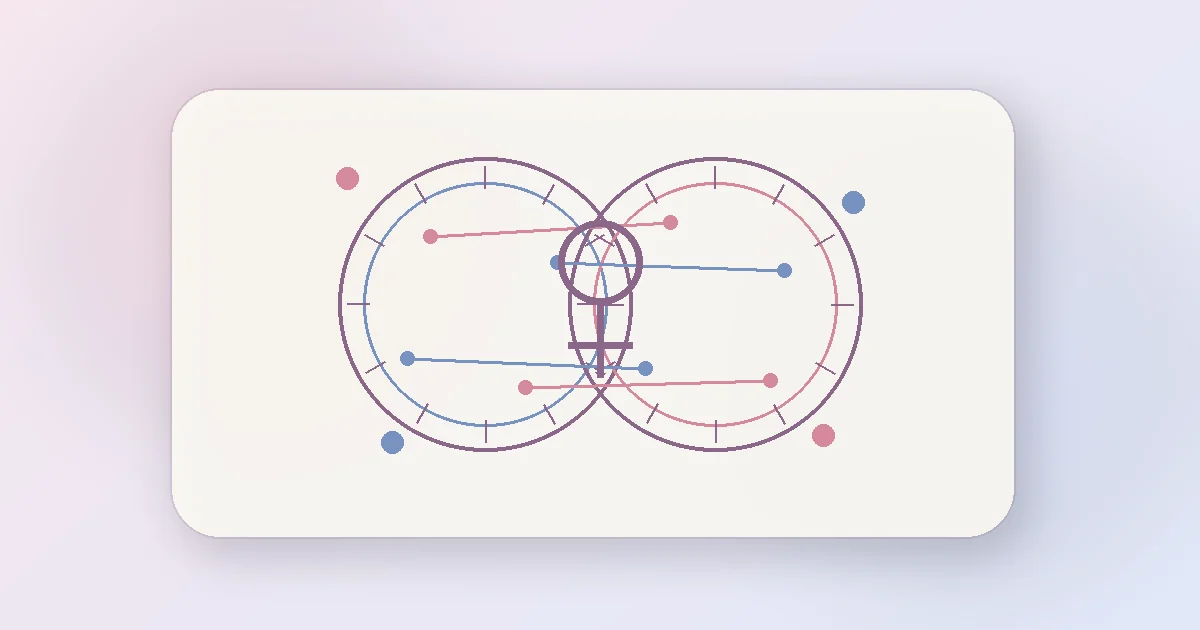
Venus in synastry describes what feels attractive, pleasant, and worth choosing in the other person, as well as how affection, enjoyment, and reciprocity are exchanged. Read the Venus sign, the partner’s house it enters, and its aspects to the partner’s planets. Venus alone cannot predict the fate or quality of a relationship.
What Venus contributes to a comparison
In astrological practice, Venus is associated with values, taste, pleasure, receiving, and the manner in which a person creates social ease. In a relationship reading this includes romance, but also money habits, leisure, the atmosphere of a shared home, physical comfort, and the small gestures that make someone feel appreciated.
Synastry compares two natal charts. One person’s Venus shows the style of attraction and valuation. The planet or point it touches in the other chart shows which function is being activated. “A difficult Venus aspect” is therefore incomplete language: Venus square Saturn describes a different task from Venus square Uranus.
Use four layers rather than one label
- Venus by sign describes the preferred style and pace of affection.
- Venus in the partner’s house locates the life area where the contact is most noticeable.
- The aspect describes the geometry of exchange. Conjunction blends and intensifies; trine and sextile make access easier; square and opposition expose a difference that needs active negotiation.
- The contacted planet names the subject: emotion, speech, desire, responsibility, freedom, idealization, or power.
Orbs and minor aspects vary by school. Begin with the closest major aspects and test each interpretation against observable interaction rather than trying to confirm every possible contact.
A practical reference for Venus contacts
| Contact | Question worth asking | Possible imbalance |
|---|---|---|
| Venus–Sun | Is the other person’s self-expression genuinely valued and encouraged? | performing for approval |
| Venus–Moon | Do care, domestic rhythm, and emotional comfort translate between the two people? | keeping peace by avoiding necessary discomfort |
| Venus–Mercury | Can affection, preferences, money, and agreements be discussed clearly? | charming language without follow-through |
| Venus–Venus | Are values, leisure, aesthetics, and ways of showing interest compatible? | expecting identical tastes |
| Venus–Mars | How do attraction, initiative, and boundaries meet? | pressure, jealousy, or rivalry |
| Venus–Saturn | Can warmth survive timing, duties, and limits? | obligation replacing voluntary closeness |
| Venus–Uranus | How much freedom, novelty, and unpredictability is workable? | abrupt distance or unstable expectations |
| Venus–Neptune | Can imagination and compassion coexist with clear facts? | idealization and vague promises |
| Venus–Pluto | How are intensity, attachment, and control handled? | possessiveness or power struggle |
No row is automatically beneficial or harmful. An easy aspect may allow avoidance to continue, while a tense aspect can make an important difference visible enough to address.
Worked example: comfort plus freedom
Suppose person A has Venus in Taurus trine person B’s Moon in Virgo, while the same Venus squares B’s Uranus in Aquarius. The Moon contact suggests a readable language of care: steadiness, practical help, sensory comfort, and respect for routine. The Uranus contact introduces a separate need for autonomy, experimentation, and occasional changes of plan.
A fatalistic reading would say that the relationship is unstable. A useful reading says that the pair needs two explicit agreements: what creates a dependable base, and what kind of independence each person can exercise without treating it as rejection. The test is behavioral—can plans change without punishment, and can reliability exist without surveillance?
Data quality and limits
Planet-to-planet aspects can usually be compared from reliable birth dates, but houses and chart angles require accurate time and place. If one birth time is unknown, treat house overlays, the Ascendant, and the Midheaven as uncertain. Do not mix tropical and sidereal positions inside one comparison without stating the method.
Synastry is a symbolic comparison, not evidence of another person’s feelings and not a substitute for consent, communication, or safety. Some astrologers add a composite chart to examine the relationship as a unit, but a composite does not override either natal chart or guarantee longevity.
Common reading errors
- using one aspect as proof of love, marriage, betrayal, or separation;
- reducing Venus to sexual chemistry and ignoring values and reciprocity;
- treating trines as guarantees and squares as verdicts;
- using house overlays when the recorded birth time is unreliable;
- claiming to know a partner’s emotions without checking words and actions;
- ignoring the Moon, Mercury, Mars, Saturn, and the wider pattern of both charts.
Practical protocol: Venus in synastry meaning
Use a short, repeatable protocol for “Venus in synastry: meaning and interpretation” rather than an unrestricted reading. This article focuses on a deeper validation of the result. The aim is to separate input data from interpretation, choose one testable conclusion, and prevent a general statement from being mistaken for a fact.
- Define the task. Write one specific question connected with “Venus in synastry meaning”. Keep it about your response, choice, or an observable situation rather than a guaranteed prediction.
- Save the inputs. Record the date, time, wording, selected method, and calculation settings. This makes it possible to explain why two results agree or differ.
- Separate the layers. Mark calculated or entered data, symbolic meaning, and your personal association as three different layers. Do not merge them into one claim.
- Choose one action. Turn the conclusion into a small step that can be completed and checked. A useful step has a deadline, a clear completion criterion, and does not depend on another person’s behaviour.
- Review the note. Return after a day or after the defined event. Compare expectation with fact, keep the useful observation, and discard wording that only seemed accurate in hindsight.
Four layers of a sound interpretation
To keep “Venus in synastry meaning” from becoming a vague description, review four layers in order:
- Input data. What was entered or selected: a date, name, question, sequence, location, or another parameter required by the method.
- Method rule. How the result was produced: a formula, correspondence table, sequence of steps, house system, construction rule, or chosen tradition.
- Interpretation. What meaning is proposed and which elements support it. A hypothesis is acceptable here; replacing facts is not.
- Practical check. Which observable action or criterion will show whether the reading was useful to you.
Extended validation example: Venus in synastry meaning
Imagine that a reader opens “Venus in synastry: meaning and interpretation” because of the query “Venus aspects in synastry”. They save the original inputs and read the direct answer first. Next, they mark one element that can be checked and connect it with “Venus in partner houses”. Instead of deciding that the result fully describes the situation, they write a working hypothesis: “Today I will test whether this emphasis helps me choose the next step.”
The reader then assigns one action and a review time. After acting, they record three facts: what was done, what changed, and which part of the interpretation added no value. This preserves the reflective use of a symbolic method without allowing broad wording to replace actual experience.
How to evaluate the result
Do not score a reading by how familiar it sounds. Score whether it clarified the situation and supported a concrete decision. Use the table as a one-result journal.
| Check | Record | Useful sign |
|---|---|---|
| Input accuracy | Date, time, wording, and selected system | The result can be reproduced |
| Fit with the question | Which part addresses “Venus aspects in synastry” | No unrelated claims are added |
| Practical action | One step connected with “Venus in partner houses” | Deadline and completion criterion are clear |
| Second review | Fact, expectation, and difference | The conclusion is refined rather than forced |
When two interpretations disagree
First check whether both readings used the same inputs and the same method. Compare the supporting elements, not the most attractive wording. When systems differ, do not combine their conclusions mechanically. Keep two separate hypotheses and prefer the one that leads to a clearer and safer action. A contradiction is a reason to refine the question, not to repeat the calculation until the answer feels pleasant.
Check a series of observations
One convincing example does not establish lasting value for “Venus in synastry meaning”. Make three comparable entries with the same method. Record the question, inputs, first conclusion, and intended action before the outcome is known. Do not change calculation rules between entries, and do not delete cases in which no connection appears.
After the third entry, sort conclusions into three groups: clarified a decision, added no noticeable value, or created a wrong expectation. Keep only wording that repeatedly helped with “Venus aspects in synastry” or “Venus in partner houses”. This small series reduces the influence of coincidence and makes personal observation more honest.
Method and source transparency
Before publishing or saving a conclusion, state which system was used and which elements are calculated data. A source may support a formula, astronomical value, historical origin, or construction rule, but it does not by itself validate a symbolic meaning. This distinction matters for “Venus in synastry: meaning and interpretation”: the reader should see where a testable rule ends and an interpretive model begins.
Sources and method references
These references support calculated, historical, or methodological parts of the article; evaluate symbolic interpretation separately.
Questions for self-review
Before saving the interpretation, answer in writing:
- What exactly do I want to understand through “Venus aspects in synastry”?
- Which part of “Venus in partner houses” describes an observable fact, and which part is my assumption?
- What will change in my action if the conclusion about “Venus Mars synastry” is useful?
- What outcome would make me revise the interpretation?
- Can I explain the result in one sentence without labels or promises about the future?
Frequently asked questions
Where should I start with “Venus in synastry: meaning and interpretation”?
Start with one question and accurate inputs. Read the direct answer, then keep only one conclusion that relates to your situation and can be reviewed.
Should the result be taken literally?
No. Calculated elements can be checked against the method, while symbolic meanings work better as observation hypotheses. They do not prove an event, diagnosis, or another person’s intention.
Why can a repeated result be different?
Inputs, time, location, name spelling, calculation rules, or the chosen tradition may have changed. With identical settings, verify the technical rule before interpreting the difference.
How do I know whether the interpretation was useful?
A useful conclusion sharpens the question, supports an action, and survives a later review. The feeling that a statement ‘sounds like me’ is not enough.
What should I save in Reflecta?
Save the question, input settings, key result elements, chosen action, review date, and a short note about what actually happened.
Related materials
Continue the topic without repeating the same query:
- Synastry: a complete beginner’s guide
- How astrological compatibility works and what the result shows
- natal chart
Continue in Reflecta
Verify the source placements in a birth chart, then compare them in astrological compatibility. Separate the immediate emotional context with the Moon guide and time-specific activation with the daily forecast.
FAQ
Where should I start with “Venus in synastry: meaning and interpretation”?
Start with one question and accurate inputs. Read the direct answer, then keep only one conclusion that relates to your situation and can be reviewed.
Should the result be taken literally?
No. Calculated elements can be checked against the method, while symbolic meanings work better as observation hypotheses. They do not prove an event, diagnosis, or another person’s intention.
Why can a repeated result be different?
Inputs, time, location, name spelling, calculation rules, or the chosen tradition may have changed. With identical settings, verify the technical rule before interpreting the difference.
How do I know whether the interpretation was useful?
A useful conclusion sharpens the question, supports an action, and survives a later review. The feeling that a statement ‘sounds like me’ is not enough.
What should I save in Reflecta?
Save the question, input settings, key result elements, chosen action, review date, and a short note about what actually happened.
Sources and editorial method
This material is intended for learning and self-reflection. It does not promise to predict the future and does not replace professional help.